

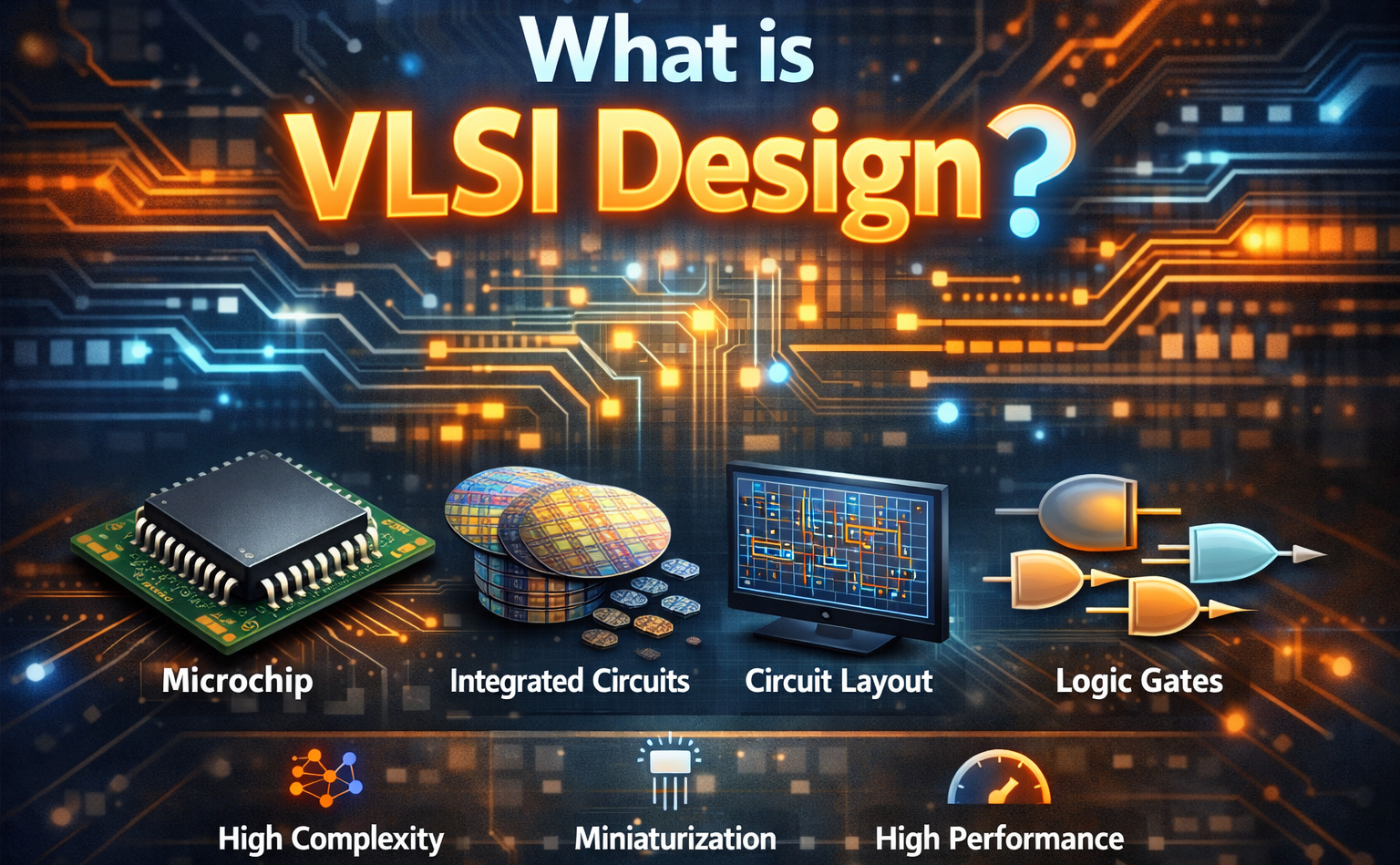
VLSI (Very Large Scale Integration) design is a key aspect of modern electronics today, because with it millions of transistors can be integrated into one chip. Almost all electronic devices, including cell phones, computers and next-generation communication systems, are based on VLSI. VLSI has revolutionised digital circuit design and has enabled the production of some of the smallest, power-saving devices on the market.
For engineers and technologists, knowledge of the VLSI design process is important because the process includes every element of planning, designing and verification needed to create small, yet highly useful, complex integrated circuits. This article will define what VLSI design is and discuss why it is important.
A Detailed Explanation of VLSI Design
- VLSI involves the integration of hundreds of thousands to billions of transistors on a single chip.
- Each transistor is like a house, and VLSI is the process that involves planning out the city to squeeze in as many houses as possible.
- The objective is to pack a very intricate electronic circuit into the smallest possible space, much like how a city planner would fit in all the necessary buildings in a small area.
Evolution of Integration Technology
- SSI (Small-Scale Integration): Looking at the evolution of electronic components, SSI marked the beginning with the introduction of the first integrated circuits, consisting of just a few dozen transistors. They were mainly used in early computers and calculators.
- MSI (Medium-Scale Integration): Increased transistor count to hundreds, enabling more complex functions like counters, decoders, and simple arithmetic circuits on a single chip.
- LSI (Large-Scale Integration): Reached thousands of transistors, giving rise to the first microprocessors and memory chips.
- VLSI (Very Large Scale Integration): Made the monumental leap to millions, and now billions, of transistors, making modern computing possible and directly reflecting Moore’s Law.
Impact of VLSI in Modern Technology
- Smartphones & Wearables: Miniaturisation and power efficiency allowed for compact, portable, and long-lasting devices, where a single System on a Chip (SoC) integrates CPU, GPU, memory, and wireless connectivity.
- Computers: Enabled powerful CPUs and GPUs, supporting faster processing speeds, high-resolution graphics, gaming, video editing, and data science applications.
- IoT (Internet of Things) Devices: Made it possible to create small, low-power sensors and microcontrollers, essential for smart homes, industrial automation, and connected vehicles.
Importance of VLSI Design
VLSI design plays a crucial role in modern electronics and computing, allowing devices to become faster, smaller, and more energy-efficient. By efficiently integrating millions of transistors on a single chip, VLSI design has transformed the way we build and use electronic systems.
Speed and Performance
- Enables high-speed processing by reducing the distance signals travel between transistors.
- Supports the creation of powerful CPUs and GPUs, allowing faster computing, real-time graphics rendering, and complex data processing.
- Improves overall system responsiveness in devices like smartphones, laptops, and gaming consoles.
Cost-Efficiency
- Integrating multiple functions on a single chip reduces the need for separate components, lowering manufacturing and assembly costs.
- Drives mass production of devices like ASICs (Application-Specific Integrated Circuits) and SoCs (System on a Chip), making advanced electronics more affordable.
Miniaturization
- Allows electronic circuits to fit into compact devices without compromising functionality.
- Essential for portable gadgets such as wearables, tablets, and smartphones, where space is limited.
- Facilitates integration of multiple components (CPU, GPU, memory, sensors) onto a single chip.
Energy Efficiency
- Reduces power consumption by optimising circuit design and transistor usage.
- Critical for battery-powered devices such as mobile phones, smartwatches, and IoT sensors.
- Supports sustainable technology development by lowering energy requirements for large-scale computing systems.
Applications of VLSI Design
- CPUs and GPUs: High-performance computing, gaming, and AI processing.
- ASICs: Custom chips for specific applications like cryptocurrency mining, network devices, or automotive electronics.
- SoCs: Integrated circuits for smartphones, tablets, and smart devices combining multiple functions on a single chip.
The VLSI Design Process
The VLSI design process is a structured series of steps that transform a conceptual idea into a fully functional integrated circuit. From defining specifications to testing the final chip, each stage ensures that the design is efficient, reliable, and meets the required performance, power, and area constraints. Understanding these stages is essential for anyone looking to grasp how modern electronic devices are created.
Stage |
Description |
|---|---|
| Specification and Requirement Analysis | This stage defines the functionality, power, and area constraints of the chip, forming the foundation for the VLSI design process and ensuring the final circuit meets the intended goals |
| System Design & Architecture | Engineers create block diagrams and functional models to plan the chip’s overall structure, allowing a clear view of how different modules interact in the VLSI design |
| RTL Design | The design is coded using Verilog or VHDL, translating system specifications into register-transfer level representation, which is a critical step in VLSI design |
| Functional Verification | Simulations are performed to ensure the RTL design behaves correctly, identifying and fixing potential errors early in the VLSI design process |
| Synthesis | RTL code is converted into a gate-level design, optimising performance and area while preparing for the next steps in the VLSI design |
| Physical Design | This stage involves floorplanning, placement, and routing, translating the gate-level design into a physical layout on silicon as part of the VLSI design process |
| Fabrication & Testing | The final chip is manufactured and tested to validate its performance, functionality, and reliability, completing the VLSI design process |
Tools Used in VLSI Design
In modern VLSI design, specialised software tools are essential for creating, simulating, and verifying integrated circuits. These tools streamline the complex VLSI design process and help engineers manage large-scale designs efficiently.
- Cadence: Cadence tools are widely used for schematic capture, simulation, verification, and physical design. They help in designing complex chips and ensure that circuits meet performance and power requirements.
- Synopsys: Synopsys provides solutions for RTL synthesis, functional verification, timing analysis, and design for testability. These tools allow designers to optimise circuits for speed, area, and power consumption.
- Mentor Graphics: Mentor Graphics offers software for physical design, PCB layout, and verification. They support tasks such as placement, routing, and sign-off, helping designers translate logical designs into manufacturable layouts.
These tools are integral to every stage of the VLSI design process, enabling faster development, higher accuracy, and better overall performance of electronic devices.
Tips for Selecting the Right Institute
- Faculty Expertise: Look for institutions with experienced faculty in VLSI and semiconductor design.
- Laboratory Facilities: Ensure access to modern labs equipped with industry-standard EDA tools.
- Industry Collaboration: Consider institutions with strong ties to the semiconductor industry for internships and placements.
- Program Flexibility: Choose programs that offer a balance of theoretical knowledge and practical experience.
Future Trends in VLSI Design
The field of VLSI design is evolving rapidly, driven by the demand for higher performance, lower power consumption, and more compact devices. Emerging technologies are shaping the future of integrated circuits and opening new possibilities for computing and electronics.
AI and Machine Learning Integration
- Design Automation: AI and machine learning are increasingly used to optimise the VLSI design process, including placement, routing, and verification.
- Predictive Analysis: Machine learning models help predict circuit behaviour, detect design flaws early, and reduce simulation time.
- Smart Chips: AI-enabled chips and processors are being designed for faster computation, energy efficiency, and adaptive learning capabilities.
Advancements in 3D ICs, FinFETs, and Nanoscale Devices
- 3D Integrated Circuits (3D ICs): Layers of chips stacked vertically to reduce interconnect delays, improve speed, and save space.
- FinFET Technology: Advanced transistor architecture offering lower leakage, higher speed, and better power efficiency.
- Nanoscale Devices: Continued miniaturisation with nanometer-scale transistors allows more transistors per chip, enabling powerful yet compact electronics.
Role of VLSI in Emerging Technologies
- Quantum Computing: VLSI principles are being adapted to design quantum processors and hybrid classical-quantum systems.
- Internet of Things (IoT): VLSI enables small, low-power, connected devices such as sensors, smart wearables, and industrial automation systems.
- Next-Generation Electronics: From autonomous vehicles to wearable medical devices, VLSI design is critical in creating efficient and intelligent hardware.
Career Opportunities in VLSI Design
The field of VLSI design offers a wide range of career opportunities for engineers and technologists. With the rapid growth of electronics and semiconductor industries, skilled professionals are in high demand for designing, verifying, and implementing complex integrated circuits. The following table highlights key roles, their responsibilities, and the industries where they are most sought after:
Role |
Description |
Industries |
|---|---|---|
VLSI Designer |
Responsible for designing digital, analog, or mixed-signal circuits, creating layouts, and ensuring the chip meets specifications | Semiconductor, Electronics, Automotive, Aerospace |
Verification Engineer |
Ensures that the designed circuits function correctly through simulation and testing, identifies and fixes design errors in the VLSI design process | Semiconductor, Electronics, Automotive, Aerospace |
Physical Design Engineer |
Handles floorplanning, placement, and routing of the chip, optimises timing, power, and area to prepare for fabrication | Semiconductor, Electronics, Automotive, Aerospace |
Conclusion
VLSI design is at the heart of modern electronics and computing, enabling the creation of powerful, compact, and energy-efficient devices. Its impact spans smartphones, computers, IoT devices, and emerging technologies like AI and quantum computing. The field continues to evolve rapidly with trends such as AI integration, 3D ICs, FinFETs, and nanoscale devices, offering exciting opportunities for innovation.
For students and professionals, exploring VLSI design as a career or area of study can lead to a wide range of roles, from designing chips and verifying circuits to working on cutting-edge research in semiconductor technology. By gaining strong theoretical knowledge, practical skills, and hands-on experience, aspiring engineers can contribute to shaping the future of electronics and play a pivotal role in the next generation of technological advancements.
FAQs