

By 2050, the world’s population is expected to cross 9 billion, and global food demand will rise by nearly 60%. Meeting this challenge requires far more than traditional farming methods, as it calls for innovation, efficiency and sustainable practices. In India, where agriculture has always been the backbone of the economy, this shift towards modernisation is especially crucial. Pursuing agricultural engineering after 12th opens the door to a discipline that blends technology with agriculture, offering solutions to challenges such as low productivity, resource wastage and climate uncertainty. From precision farming and irrigation systems to renewable energy and food processing, agricultural engineers are shaping the future of food security.
In this article, you will discover the top reasons to choose a career in agricultural engineering after 12th. You will see how the field is moving beyond farms into high-tech industries, the rising demand for skilled professionals and the opportunities that make this career both impactful and future-ready.
What is Agricultural Engineering?
Agricultural engineering is the application of engineering principles to agriculture. It focuses on improving the production, processing and management of food and other biological resources. The discipline blends technology with traditional practices to make farming more efficient, sustainable and profitable.
What You'll Study
Students study a variety of subjects that cover different aspects of agriculture and engineering:
- Soil and Water Conservation Engineering – Techniques for sustainable land use and efficient water management
- Farm Machinery and Power Engineering – Design and operation of agricultural machinery to improve productivity
- Irrigation and Drainage Systems – Planning and managing water resources for optimal crop growth
- Food Processing and Post-Harvest Technology – Handling, preservation, and value addition of agricultural produce
- Renewable Energy in Agriculture – Using solar, biofuels, and other sustainable energy solutions for farming
Top Reasons to Choose Agricultural Engineering After 12th
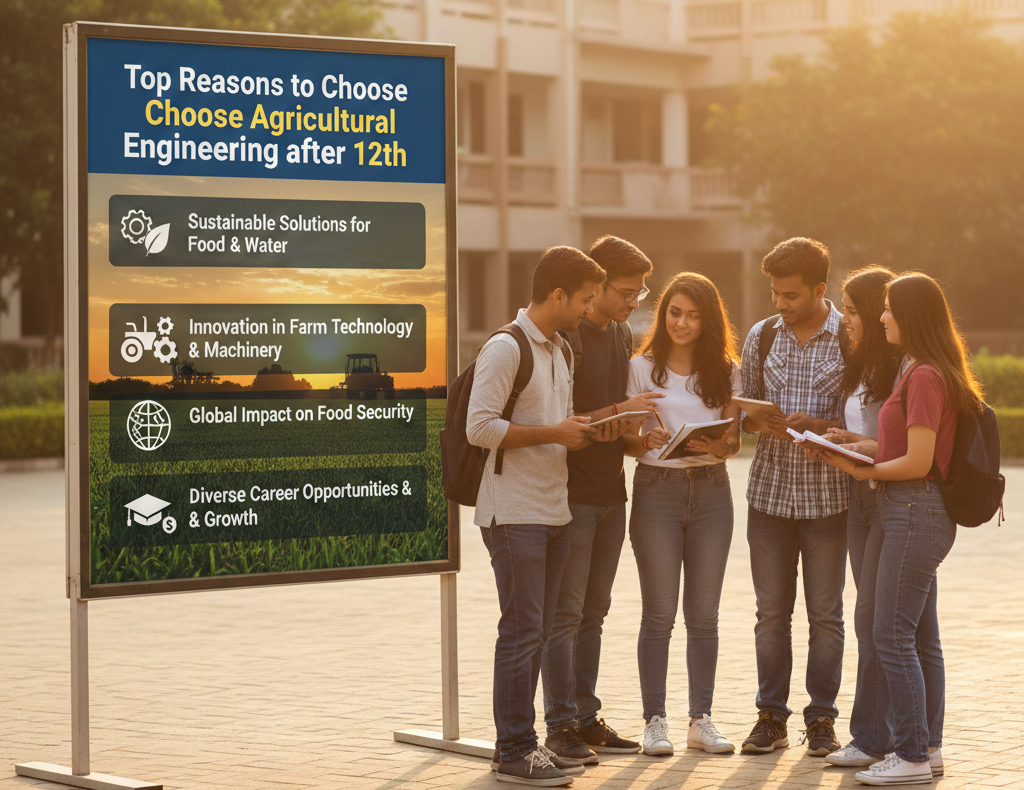
Agricultural engineering is more than just farming; it blends technology with sustainability and offers students a chance to solve global challenges like food security. Here are the key reasons why pursuing agricultural engineering after 12th can be a smart career choice:
Contribution to Food Security and Sustainability
- Agricultural engineers design efficient equipment and systems that help increase crop yields to meet rising food demand.
- The field promotes sustainable practices such as precision irrigation systems and organic farming tools.
- Engineers ensure that future generations have access to safe and sufficient food.
Diverse Career Options
- Opportunities exist in government departments, private companies, agribusinesses, and research organisations.
- Students can pursue higher studies like MTech or PhD to specialise further and build careers in academia or R&D.
- This variety of options makes a career in agricultural engineering after 12th suitable for different ambitions.
Technological Integration in Agriculture
- Uses AI, IoT, drones, and other smart solutions to create automated and data-driven farming systems.
- From drone-based crop monitoring to sensor-driven irrigation, agricultural engineers make farming precise and efficient.
- Tech-savvy students find this field exciting, as it combines engineering innovation with agricultural needs.
Growing Job Opportunities in India & Abroad
- In India, sectors like agribusiness, food processing, irrigation companies, and government projects are actively hiring.
- Globally, the demand for skilled professionals is rising due to concerns around food security and sustainable farming.
- A degree in agricultural engineering after 12th opens doors to careers at home and abroad.
Entrepreneurship Potential
- Students with an entrepreneurial spirit can start agritech ventures, food processing units, or farm machinery businesses.
- Modernisation in agriculture offers significant scope for innovative solutions and new startups.
Government Support and Incentives
- Subsidies, schemes, and rural development initiatives from the government encourage growth in this field.
- Supportive policies create more jobs and help young engineers launch entrepreneurial ventures.
Top Institutions Offering Agricultural Engineering & Related Courses After 12th
Institution Name |
Course |
Course Highlights |
Eligibility |
|---|---|---|---|
IIT Kharagpur |
B.Tech (Hons.) in Agricultural and Food Engineering | Focus on mechanisation, processing, and tech-driven solutions | 10+2 with Physics, Chemistry, Maths; JEE Advanced |
NITs |
B.Tech in Agricultural Engineering | Emphasis on irrigation, machinery, and sustainability | 10+2 with Physics, Chemistry, Maths; JEE Main |
ICAR-Accredited Institutes |
B.Tech / B.Sc (Hons.) in Agricultural Engineering | Research-oriented, hands-on training in modern farming | 10+2 with Science (PCM); ICAR AIEEA entrance |
Jagannath University |
B.Tech Agriculture Engineering, B.Sc (Hons.) in Agriculture | Practical and project-based education; one-semester RAWE internship; industrial exposure; interdisciplinary curriculum | 10+2 with Physics, Chemistry, Biology/Mathematics/Agriculture; minimum 50% aggregate marks; CUET (UG)/ REAP/JEE/ JUEE/ |
Career Paths and Job Roles After Obtaining an Agricultural Engineering Degree After 12th
Agricultural engineering offers a wide range of career opportunities that go far beyond traditional farming. The field combines technology, research, and management, allowing students to work on innovative solutions for modern agriculture. With the right skills, graduates can choose from technical, managerial, research, and tech-focused roles that impact food production, sustainability, and agribusiness.
Diverse Careers in Agricultural Engineering
- Irrigation Engineer – Designs and manages efficient water supply systems, implements modern irrigation technologies, and ensures optimal water use to maximise crop yields.
- Farm Manager – Oversees all aspects of farm operations, including machinery, workforce, and crop management, while implementing modern techniques and technologies.
- Food Processing Engineer – Works on post-harvest handling, food preservation, packaging, and safety standards, ensuring quality and reducing wastage.
- Agricultural Research Scientist – Researches to develop new crop varieties, sustainable farming methods, and innovative agricultural technologies.
- Precision Agriculture Specialist – Uses GPS, drones, IoT sensors, and data analytics to monitor fields, improve productivity, and make farming more precise and efficient.
Top Recruiters and Sectors
Graduates of agricultural engineering find opportunities in a variety of sectors, each offering unique challenges and growth prospects
- Government Bodies – Organisations such as ICAR, NABARD, and state agricultural departments hire engineers for research, policy implementation, and rural development projects.
- Private Corporations – Companies like John Deere, Nestle, and other agribusiness firms recruit engineers for machinery design, farm management, and food processing.
- Technology Startups – Agritech startups focus on precision farming, smart irrigation, robotics, and automation, creating exciting roles for tech-savvy professionals.
This diversity in job roles and sectors ensures that students can build a fulfilling career while contributing to modern agriculture and food security
Salary Scope and Future Growth for Agriculture Engineers
A career in agricultural engineering not only offers the satisfaction of contributing to modern agriculture but also provides a promising earning potential that grows with skills and experience.
-
Average Starting Salaries in India
- Entry-level salaries for agricultural engineers in India typically range between ₹3 lakh and ₹6 lakh per annum, depending on the employer, location, and role.
- Positions in research, agribusiness, or private companies using modern technologies may offer salaries at the higher end of this range.
-
Government vs Private Sector Jobs
- Government Jobs – Roles in organisations like ICAR, NABARD, and state agricultural departments offer job stability, benefits, and long-term security, though starting salaries may be moderate.
- Private Sector Jobs – Positions in agribusiness, food processing firms, irrigation companies, and agritech startups can offer higher starting salaries, performance incentives, and faster career growth.
-
Long-Term Growth Opportunities
- With experience, specialisation, and higher qualifications (such as M.Tech or PhD), agricultural engineers can progress into senior management, research leadership, or entrepreneurial roles.
- Salaries can rise significantly, often exceeding ₹10 lakh per annum in private-sector or consultancy positions.
- Career advancement also includes opportunities to lead innovation projects, implement technology solutions, or establish agritech ventures, making this field highly rewarding in the long run.
This combination of stability, growth, and diverse opportunities makes agricultural engineering a promising choice for students looking for both impact and a strong career trajectory.
Skills Required for Agricultural Engineers
To succeed in this field, agricultural engineers need a combination of technical and soft skills that allow them to design, innovate, and adapt to modern agricultural challenges.
-
Technical Skills
- CAD (Computer-Aided Design) – for designing farm machinery and equipment.
- GIS (Geographic Information Systems) – for mapping land use, soil types, and irrigation planning.
- Data Analysis – to interpret agricultural data and make informed decisions.
- Machinery Design – understanding and developing efficient tools and automated systems for farming.
-
Soft Skills
- Problem-Solving – to tackle real-world challenges in agriculture effectively.
- Innovation – to develop new methods, technologies, and sustainable solutions.
- Adaptability – to work in a rapidly evolving, technology-driven agricultural environment.
Conclusion
Choosing agricultural engineering after 12th is a promising path for students seeking a career that combines technology, innovation, and real-world impact. The field is in high demand, offering diverse roles in government, private companies, research, and emerging agritech sectors. It allows students to work with modern tools like drones, GIS, and smart irrigation systems while contributing to sustainability and global food security.
With a curriculum that blends engineering principles, agricultural science, and practical skills, graduates are well-equipped for meaningful careers that make a difference. From designing efficient water systems and modern farm machinery to developing sustainable solutions for food production, the opportunities are vast and rewarding. For students passionate about technology, sustainability, and shaping the future of agriculture, this is a field where ambition meets purpose. It is a chance to not only build a successful career but also play a vital role in feeding the world and protecting the environment.
FAQs