

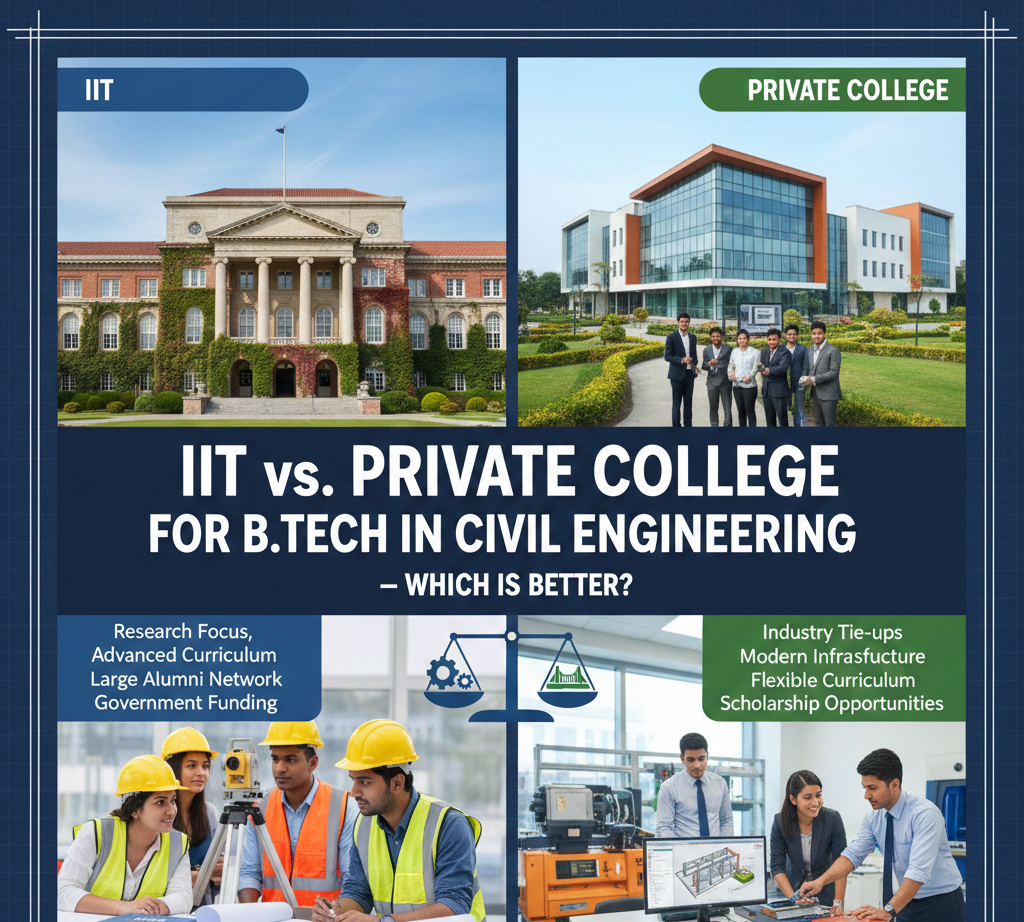
Once you have finished your schooling, you may be wondering whether to pursue an IIT or a private university for your B.Tech in civil engineering. Rest assured, you are not the only one who is wondering the same question. It can also become a difficult choice to choose between an IIT and a reputed private college as they both provide quality education, exposure and growth opportunity in their own way.
It is important to know the top Civil Engineering colleges in India. These institutions not only develop you technically but also lead you into your future growth, network development, and job placement. Knowing these elements allows students to make a decision which supports long-term vision and career objectives.
When comparing an IIT and a private university, it's important to think beyond the brand. The IIT vs. private university discourse is comprised of lecture style, facilities, industry connections, and your own learning style. In this article, we will explain the key differences, advantages, and considerations that come along with both choices while also encouraging you to think critically and make your own decision for your future in civil engineering.
What is B.Tech Civil Engineering?
- In this undergraduate program, you will learn how to design, construct, and operate physical infrastructures such as bridges, buildings, roads, and water systems.
- It uses concepts from materials science, physics, and mathematics to address real-world engineering challenges.
- The major topics include Structural Engineering, Geotechnical Engineering, Environmental Engineering, Transportation Engineering, and Construction Management.
Career Opportunities and Industry Relevance After B.Tech in Civil Engineering
- Graduates can pursue roles as Civil Engineers, Structural Engineers, Project Managers, and Environmental Consultants.
- Opportunities exist in construction firms, infrastructure development companies, government agencies, and research organisations.
- The degree equips students with skills in project planning, design, and sustainable development, making it highly relevant to modern industry demands.
- Choosing from the top colleges for Civil Engineering in India can provide exposure to advanced labs, internships, and industry connections, enhancing employability.
Comparing an IIT and a Private University's B.Tech Civil Engineering Programs
Choosing between an IIT and a private university for a B.Tech in Civil Engineering involves more than just brand recognition. Each option offers unique advantages in academics, infrastructure, career opportunities, and campus culture. Comparing these aspects can help students make an informed decision about their future in engineering.
Particular |
IITs |
Private Colleges |
|---|---|---|
Academic Rigour and Faculty Quality |
Focus on highly qualified, research-oriented faculty and rigorous curriculum | Range of faculty experience; practical and industry-oriented curriculum in top-tier institutions |
Infrastructure and Research Opportunities |
State-of-the-art labs, government-funded research projects, and global collaboration | Quality varies; some invest heavily in niche labs or corporate partnerships |
Placement and Career Trajectory |
Unmatched brand value, top-tier core and non-core companies, high to average salary | Placements depend on college rank and industry connections; may require more self-effort for core sector jobs |
Fees and Financial Aid |
Subsidised fees with extensive scholarship and loan options | Generally higher fees; financial aid offered often performance-based |
Peer Group and Campus Culture |
Highly competitive, meritocratic, strong focus on technical clubs and innovation | More diverse student base, broader range of cultural and entrepreneurial activities |
This comparison highlights the key differences between IITs and private universities, helping students evaluate what matters most for their career, learning style, and personal growth in civil engineering.
Pros and Cons of Pursuing Engineering from the IITs
Pros |
Cons |
|---|---|
| Global recognition and strong alumni network | Admission is extremely competitive (JEE Advanced) |
| Highly qualified faculty and advanced research facilities | High academic pressure and workload |
| Lower tuition fees due to government subsidy | Limited flexibility in curriculum |
| Excellent placements in core Civil and R&D roles | Limited seats, not everyone gets top opportunities |
| Strong government-funded labs and international collaborations | Campus lifestyle less flexible compared to some private universities |
Pros and Cons of Pursuing Engineering from Private Colleges
Pros |
Cons |
|---|---|
| Easier admission through exams like SRMJEEE, LPUNEST, or direct entry | Quality of education varies widely across institutions |
| Modern infrastructure and industry-focused curriculum | Higher fees compared to IITs |
| Flexible course structure and elective choices | Research opportunities not as strong as IITs |
| Scholarships and financial aid available | Global recognition usually lower than IITs |
| Good placements in reputed colleges (BITS, SRM, VIT, LPU, JU etc.) | Core Civil job roles weaker in average colleges |
Factors to Consider Before Choosing a Civil Engineering College
Selecting the right college to pursue B.Tech Civil Engineering is not just about brand name or rankings. Several key factors can significantly impact your learning experience, skill development, and career prospects.
Placement Opportunities
- Check the college’s track record for campus placements, including the range of companies visiting and average salary packages.
- Look for connections with core engineering sectors and opportunities for internships that can enhance practical experience.
Faculty and Curriculum
- Evaluate the qualifications, experience, and research orientation of the faculty.
- Ensure the curriculum is updated, industry-relevant, and offers a balance of theory, practical labs, and project work.
Infrastructure and Technology
- Modern laboratories, workshops, and computer facilities are essential for hands-on learning.
- Access to advanced tools, software, and research facilities enhances practical skills and innovation.
Fees and Scholarships
- Compare tuition fees and additional costs to ensure affordability.
- Explore scholarships, financial aid, and loan options offered by the college to support meritorious or economically weak students.
Location and Lifestyle
- Consider proximity to industrial hubs, transportation, and city facilities.
- Campus culture, extracurricular activities, and overall lifestyle can affect personal growth and networking opportunities.
Taking all these factors into account helps students make a well-informed decision that aligns with both academic goals and long-term career aspirations.
Conclusion
Both IITs and private universities bring unique advantages for students pursuing B.Tech in Civil Engineering. IITs stand out for their rigorous academics, government-backed research, subsidised fees, and unmatched brand value. Private universities, on the other hand, often provide modern infrastructure, industry-focused curricula, and diverse opportunities in cultural and entrepreneurial activities.
The choice between the two depends on your priorities. If you value a highly competitive environment, extensive research exposure, and long-term brand recognition, IITs may be the right fit. If you prefer practical industry exposure, flexible learning opportunities, and a broader campus culture, private universities could be a better option.
Students should carefully assess factors like placements, faculty expertise, infrastructure, financial considerations, and location before making a decision. Aligning these with your career goals and learning style will ensure that whichever path you choose sets a strong foundation for growth in civil engineering.
FAQs