

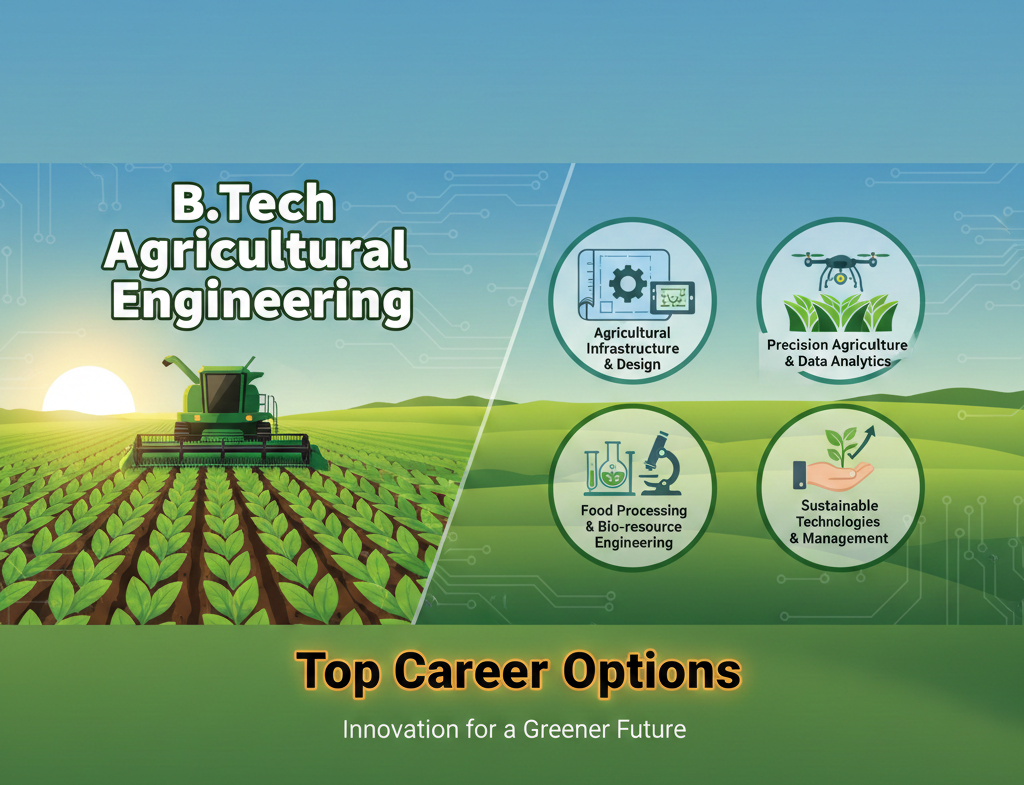
As the world is increasingly focused on food security and sustainable agriculture, agricultural engineers are more valuable than ever to society. Careers in agricultural engineering go beyond agriculture. Agricultural engineering utilises technology, innovations and engineering principles to maximise agricultural production, enhance efficiencies and develop approaches to solving environmental challenges.
When you graduate with a B.Tech in Agricultural Engineering, exciting career opportunities await. This article will discuss the best career options after B.Tech Agriculture, the type of jobs that are offered and aspects that would help in building a good career.
What is B.Tech in Agricultural Engineering
B. Tech Agriculture Engineering is an undergraduate degree program that integrates engineering technology to promote agricultural efficiency.
- Interdisciplinary – integrates mechanical, civil, electrical, and computer engineering with agriculture
- Technology-Centred – addresses agricultural implements, irrigation, soil mechanics, and post-harvest technology
- Problem-Solving Methodology – teaches students to create new solutions for problems in contemporary agriculture
- Research and Development – students learn to design devices, technologies, and sustainable agriculture systems
- Industry Ready – students learn the competencies and skills they will need as agricultural engineering practitioners with industry or government
Why You Should Choose B.Tech in Agricultural Engineering as Your Career
Choosing a career in agricultural engineering opens up a world of opportunities. It is here where technology meets farming. Agricultural Engineering jobs are no longer limited to traditional roles; they now include innovation, research, and management. Understanding the benefits of this field can help you make an informed decision about your career after B.Tech Agriculture.
-
High Demand for Skilled Professionals
- The growing global focus on food security and sustainable farming is driving the need for experts in agricultural engineering
- Organisations across the public and private sectors actively seek graduates for various Agricultural Engineering jobs
- Top universities such as IIT Kharagpur, NITs, and ICAR-accredited institutes provide high-quality education, research exposure, and industry connections, preparing students to meet sector demands
-
Diverse Career Opportunities
- Graduates can explore roles in farm mechanisation, irrigation systems, soil and water conservation, food processing, and agri-business management
- There is a wide range of career options after B.Tech Agricultural Engineering, catering to both technical and managerial interests
- Institutes like BITS Pilani, Lovely Professional University, SRM University, and Jagannath University equip students with the practical skills and knowledge needed for these diverse roles
-
Technology-Driven and Innovative Field
- Modern agriculture increasingly relies on technology, robotics, and smart farming solutions
- Students gain hands-on experience with advanced tools and techniques, preparing them for futuristic Agricultural Engineering jobs
-
Contribution to Society and Sustainability
- Agricultural engineers play a key role in improving crop yields, reducing resource wastage, and supporting environmentally friendly farming
- Careers in this field allow you to make meaningful contributions while exploring diverse career options after B.Tech. in Agricultural Engineering
-
Lucrative Salary and Growth Potential
- Competitive salaries and rapid career progression are common in both public and private sectors
- Specialisations and higher studies can further enhance earning potential and open up advanced Agricultural Engineering jobs
Top Career Options After B.Tech Agricultural Engineering
A B.Tech in Agricultural Engineering opens doors to a variety of career paths in both the public and private sectors. Graduates can explore roles that match their technical skills, interests, and long-term goals while contributing to sustainable and innovative agricultural practices.
Career Path |
Key Opportunities |
Important Details |
|---|---|---|
| Agricultural Engineer in Government Sector | Positions in ICAR, State Agriculture Departments, NABARD; contributing to policy, research, and rural development | Competitive exams for roles like Agricultural Research Scientist, Agricultural Development Officer; field inspections, technical advisory |
| Agri-Business & Farm Management | Starting agribusinesses, managing large farms, consultancy roles | Technical knowledge plus business acumen, project management, communication skills |
| Research & Development (R&D) | Roles in research institutes, universities, private agri-tech companies; developing new technologies and sustainable practices | Higher studies like M.Tech or PhD often required; innovation and problem-solving skills |
| Irrigation & Soil Conservation Expert | Designing irrigation systems, soil management, sustainable agriculture projects | Knowledge of water conservation, soil science, climate-resilient farming techniques |
| Agricultural Equipment & Machinery Specialist | Manufacturing, sales, maintenance of farm machinery; roles in agritech startups | Mechanical and technical expertise, understanding of automated and AI-powered farm equipment |
| Quality Control & Food Processing Jobs | Food industry roles, quality inspection, compliance with FSSAI standards | Knowledge of food safety, quality control processes, production optimization |
| Environmental & Sustainable Agriculture Careers | Working in NGOs, climate-smart agriculture, organic farming initiatives | Understanding of environmental science, sustainable practices, agricultural waste management |
Higher Studies & Specialisations After B.Tech in Agriculture Engineering
Pursuing higher education after a B.Tech in Agricultural Engineering can significantly enhance your career prospects and open doors to specialised roles. Graduates looking to deepen their expertise or move into leadership positions often consider advanced degrees to gain a competitive edge and expand their career after B.Tech Agriculture.
-
M.Tech in Agricultural Engineering or Related Specialisations
- Allows for focused study in areas such as Farm Power and Machinery, Soil and Water Engineering, or Food Process Engineering
- Prepares graduates for research-oriented roles, advanced technical positions, and innovative projects within the field
-
MBA in Agribusiness Management
- Ideal for those aiming to transition into management, entrepreneurial ventures, or consultancy roles in agriculture
- Equips students with business strategy, project management, and leadership skills to complement their technical knowledge
-
Benefits of Higher Education for Career Growth
- Advanced degrees often lead to higher-paying positions, senior-level roles, and specialised opportunities
- Expands prospects across research, academia, policy-making, and industry leadership, providing a diverse range of career options after B.Tech Agriculture
Future Trends in Agricultural Engineering
The field of agricultural engineering is at the forefront of innovation, driven by the need for increased efficiency and sustainability. Graduates entering this profession can expect to work with cutting-edge technologies and adapt to emerging trends shaping the future of agriculture.
-
Robotics and Automation
- Use of autonomous tractors, robotic harvesters, and drones is becoming more common
- Tasks like planting, weeding, and spraying are performed with increased speed and precision
- Reduces labour costs and human effort while improving productivity
-
Data Analytics and IoT
- Sensors and interconnected devices (Internet of Things) are widely used to collect data
- Engineers analyse large datasets to make real-time decisions about irrigation, fertilisation, and pest control
- Leads to more efficient resource management and optimised crop production
-
Regenerative and Climate-Smart Agriculture
- Focus on developing practices that restore soil health and sequester carbon
- Builds resilience against extreme weather events and adapts farming to climate change
- Engineers are increasingly specialising in sustainable and regenerative agricultural techniques
-
Vertical Farming and Controlled Environments
- Limited arable land is driving the growth of vertical farms and controlled-environment agriculture
- Engineers design systems to regulate light, temperature, humidity, and nutrients for year-round production
- Enables urban farming and maximises space efficiency
-
Advanced Biotechnology
- Collaboration with biologists and geneticists to develop pest, disease, and drought-resistant crops
- Techniques like CRISPR are used to improve crop resilience and yield
- Essential for ensuring food security in a changing global environment
Conclusion
A B.Tech in Agricultural Engineering opens doors to a diverse and rewarding range of opportunities. Graduates can explore roles in government, research, agri-business, equipment design, and sustainable farming while contributing to global food security and innovation. The field is evolving rapidly with trends like robotics, data analytics, vertical farming, and advanced biotechnology, offering exciting prospects for those ready to embrace technology and creativity.
Understanding the various pathways after completing your degree and the skills required helps in making informed decisions about the future. With options for higher studies like M.Tech and MBA, alongside practical experience, students can build a strong career after B.Tech Agriculture that is both impactful and fulfilling. Whether your goal is research, entrepreneurship, or management, the possibilities are vast and growing, making it a promising choice for the next generation of engineers.
FAQs