
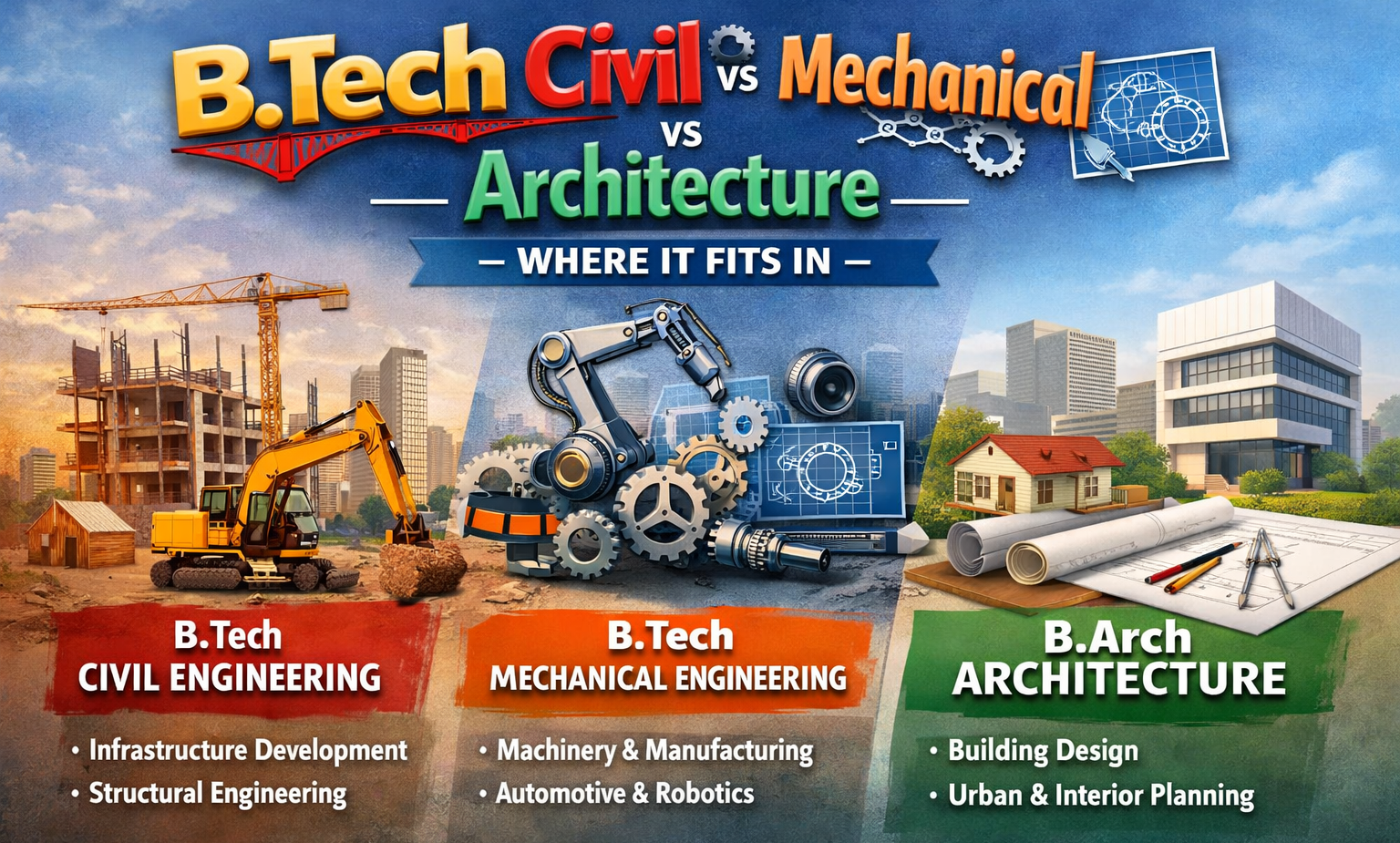
Selecting the appropriate career path after high school can seem like one of the most difficult decisions of your life. It happens especially when choosing between engineering and architecture, as it outlines your whole academic and career path. Many students compare B.Tech Civil vs Mechanical vs Architecture as they are some of the most common and most considered disciplines; however, all three offer a different focus.
For example, choosing between the three can lead to a dilemma. Civil engineering is about designing and maintaining infrastructure like bridges and roads, while architecture is rooted in creativity and spatial design. Mechanical engineering stands apart as one of the most versatile areas, opening doors in industries from automobiles to robotics.
In this article, you’ll find a clear comparison of B.Tech Civil vs Mechanical and B.Arch and practical guidance to help you identify the best field for your future.
Understanding the Core Differences Between B.Tech Civil, B.Tech Mechanical and Architecture
Many students find themselves torn when comparing mechanical engineering vs architecture or even deciding between B.Tech Civil vs B.Arch since these paths seem equally promising. Yet each comes with its own learning style, career focus and opportunities. The table below will help you see the core differences in what you’ll study, how the courses are structured and where each field truly fits in your career journey:
Course |
Focus |
What You’ll Study |
Course Structure & Duration |
|---|---|---|---|
B.Tech in Civil Engineering |
● The “Builder” | Structural analysis, fluid mechanics, geotechnical engineering, transportation engineering | 4 years divided into 8 semesters with theory, lab work and compulsory internships |
| ● Civil engineers are the backbone of infrastructure development working on the design construction and maintenance of large-scale projects like bridges, dams, roads and buildings | |||
B.Tech in Mechanical Engineering |
● The “Innovator” | Thermodynamics, fluid dynamics, machine design, mechatronics, robotics | 4 years divided into 8 semesters including workshops, lab sessions and industry projects |
| ● This is the science of motion energy and machines | |||
| ● Mechanical engineers design analyse and manufacture everything from car engines to robotic systems | |||
Bachelor of Architecture (B.Arch) |
● The “Designer” | Architectural design, building materials, history of architecture, structural systems | 5 years with 10 semesters consisting of studio work, design projects and mandatory training |
| ● Architects are the creative visionaries who shape the aesthetics functionality and spatial experience of buildings while ensuring they are practical and sustainable |
Career Scope & Job Roles: B.Tech Civil vs B.Tech Mechanical vs Architecture
When deciding between the best engineering field (Civil or Mechanical) and B.Arch, it’s important to understand the career opportunities each path offers. This table compares B.Tech Civil Engineering vs B.Tech Mechanical Engineering vs Bachelor of Architecture (B.Arch) in terms of common job roles and major employers:
Field |
Career Scope |
Common Job Roles |
Major Employers |
|---|---|---|---|
Civil Engineering |
High demand in infrastructure projects, urban planning, and construction management | Structural Engineer, Site Engineer, Urban Planner, Geotechnical Engineer, Project Manager | Private construction firms (L&T, Tata Projects), Public sector (NHAI, PWD, municipal corporations), Real estate developers |
Mechanical Engineering |
Versatile across industries including manufacturing, robotics, energy, and automotive | Robotics Engineer, Automotive Designer, HVAC Engineer, Production Engineer, Thermal Systems Engineer | Automotive companies (Tata Motors, Maruti Suzuki), Aerospace firms (ISRO, HAL), Manufacturing units, Energy companies (NTPC, BHEL) |
Architecture |
Design-focused careers in building planning, interior design, and urban development | Residential Architect, Landscape Architect, Urban Designer, Interior Designer, Project Architect | Architecture firms, Real estate developers, Government planning bodies, Interior design studios, Urban development authorities |
Which is the Best Field for You?
When comparing B.Tech Civil vs B.Tech Mechanical vs B.Arch, it’s important to remember that there is no single right answer. The choice depends on your strengths, interests, and long-term career goals. Each field offers unique opportunities and challenges, so your decision should align with what excites you the most.
-
Civil Engineering
- Ideal if you are passionate about infrastructure development and urban growth
- Offers career opportunities in construction, public works, and sustainable development
- A strong choice when your interest is more technical than creative
-
Mechanical Engineering
- Best suited if you enjoy working with machines, energy systems, and automation
- Versatility across industries like manufacturing, aerospace, robotics, and energy
- Often seen as one of the best engineering fields for its wide applications
-
Architecture
- Perfect for students with a creative mindset and an eye for design and aesthetics
- Focuses on spatial planning, building functionality, and sustainable design
- In the debate of Civil vs Mechanical vs Architecture, this option is more design-focused than purely technical
Conclusion
Deciding between B.Tech Civil vs B.Tech Mechanical Engineering vs Bachelor of Architecture is not about choosing the most popular option but about recognising where your interests and abilities truly fit. While B.Tech Civil and B.Arch reflect the contrast between technical problem-solving and creative design, Mechanical Engineering brings versatility across multiple industries. Each field has its own scope, challenges, and rewards, making it impossible to declare a single best engineering field for everyone.
What matters most is aligning your choice with your passion. Whether you dream of shaping skylines, driving technological innovation, or building the nation’s infrastructure, there is a path that matches your vision. Your future begins with the decision you make today, so choose confidently, stay committed, and take the next step towards building a career that excites and fulfils you.
FAQs