
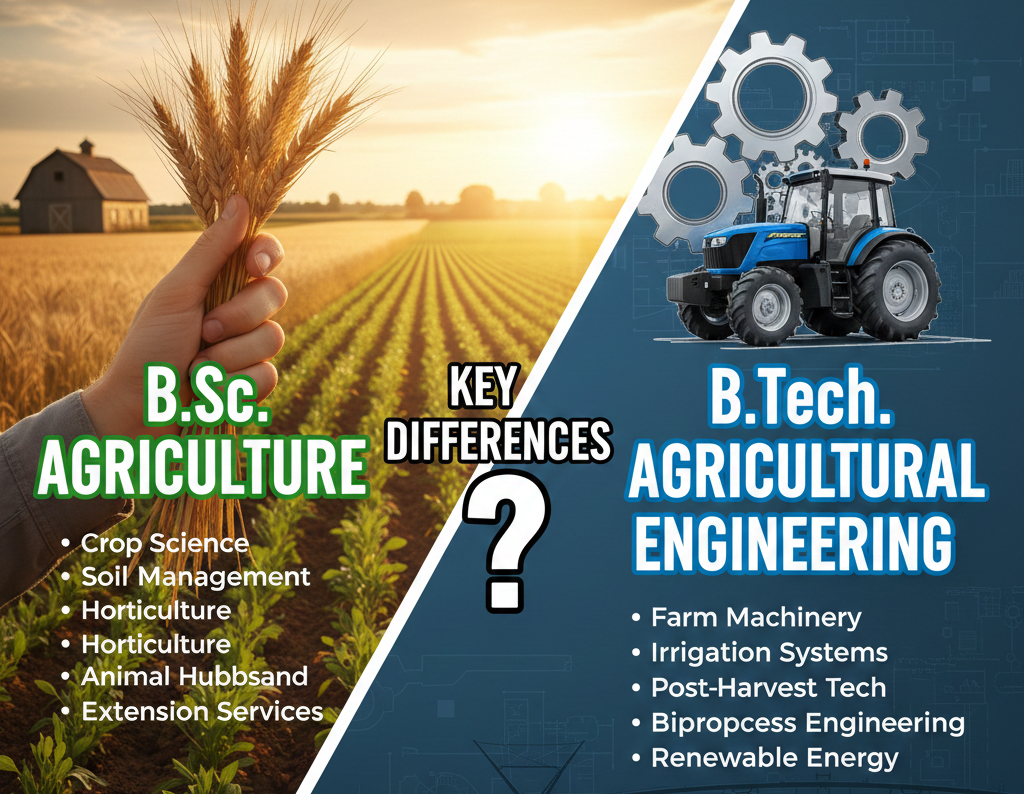
Agriculture has always been the backbone of our economy, and with technology shaping every sector, its importance is only growing. Students looking to build a career in this field often find themselves caught in the dilemma of choosing between B.Sc Agriculture vs B.Tech. Agricultural Engineering.
This article is here to make the difference between B.Sc Agriculture and Agricultural Engineering clear, so you can choose the path that matches your interests and strengths. Along the way, you will also explore the career options after B.Sc Agriculture and the career options after B.Tech. Agricultural Engineering, helping you picture where each course could take you.
If you see yourself working closely with crop science and farm management, or if you are more inclined towards designing tools, machines and systems for farming, this guide will help you decide which direction suits you best.
What is B.Sc Agriculture?
B.Sc Agriculture is a four-year undergraduate programme that focuses on applying science and technology to improve agricultural productivity and sustainability. It equips students with knowledge of crops, soils, pests and farm economics while also addressing modern agricultural challenges such as food security and resource management.
Core Curriculum & Subjects
- Agronomy and Soil Science – Study of soil properties, crop management and techniques to enhance agricultural yield
- Plant Pathology, Entomology and Genetics – Understanding plant diseases, pests and the role of genetics in developing resilient crop varieties
- Agricultural Economics and Extension – Learning about farm economics, rural development and methods to transfer technology to farmers
- Horticulture and Animal Husbandry – Focus on the cultivation of fruits, vegetables, flowers and management of livestock for integrated farming systems
What is B.Tech Agricultural Engineering?
B.Tech Agricultural Engineering is a four-year undergraduate degree that applies engineering principles to agriculture with a focus on designing, developing and improving farming equipment systems and infrastructure. It prepares students to address challenges such as mechanisation, irrigation, post-harvest losses and sustainable resource management through technology-driven solutions.
Core Curriculum & Subjects
- Farm Machinery and Power Engineering – Study of agricultural machines, their design, operation and maintenance for efficient farming practices
- Soil and Water Conservation Engineering – Techniques to manage soil erosion, conserve water and ensure sustainable land use
- Irrigation and Drainage System Design – Designing systems for effective water distribution and drainage to maximise crop productivity
- Post-Harvest Technology and Food Process Engineering – Understanding methods to reduce crop losses, improve storage and process food efficiently
- Agricultural Structures and Environmental Control – Designing farm structures like storage units, greenhouses and systems for controlled environments to support modern farming
B.Sc Agriculture vs. B.Tech. Agricultural Engineering Key Differences
Choosing between B.Sc Agriculture and B.Tech. Agricultural Engineering can be confusing, as both focus on farming, but their approach and career paths differ. Understanding the key differences helps students pick the path that matches their skills and interests.
Parameter |
B.Sc Agriculture |
B.Tech Agricultural Engineering |
|---|---|---|
Primary Focus |
Biological, agronomic, and economic aspects of farming. | Design, development, and application of technology in agriculture. |
Core Subjects |
Soil Science, Genetics, Agronomy. | Farm Machinery, Hydraulics, Thermodynamics. |
Skillset |
Field management, advisory, sales, biological analysis. | Engineering design, problem-solving, construction, maintenance. |
Entry Requirements |
Often focuses on PCB or PCM depending on state regulations. | Primarily PCM (Physics, Chemistry, Mathematics). |
Career Orientation |
Crop production, farm management, advisory roles. | Machinery design, irrigation systems, infrastructure, and technology application. |
Research & Innovation |
Crop improvement, pest management, soil fertility studies. | Development of new farming equipment, automation, precision agriculture. |
Practical Exposure |
Farm visits, field experiments, crop trials. | Workshops, labs, machinery testing, irrigation system design. |
Software & Tools |
Agricultural statistical tools, farm management software. | CAD software, simulation tools, mechanisation and hydraulics software. |
Industry Opportunities |
Government agriculture departments, research institutes, agri-business. | Agro-machinery companies, irrigation firms, food processing, consulting. |
Course Duration |
Typically 4 years. | Typically 4 years. |
Curriculum Overview |
Emphasis on agricultural sciences, crop production, and farm management. | Emphasis on engineering principles, machinery design, and infrastructure development. |
Top Institutions |
||
| Indian Agricultural Research Institute (IARI) | IIT Kharagpur | |
| Punjab Agricultural University (PAU) | IIT Roorkee | |
| Tamil Nadu Agricultural University (TNAU) | Indian Institute of Science (IISc), Bangalore | |
| University of Agricultural Sciences (UAS), Dharwad | Mahatma Phule Krishi Vidyapeeth (MPKV), Rahuri | |
| Jagannath University, Jaipur | ||
Career Paths and Scope After Obtaining a Degree in Agriculture Studies
After completing a degree in agriculture or agricultural engineering, students have a variety of rewarding opportunities that align with their interests and skill sets. Understanding the career options after B.Sc Agriculture and the career options after B.Tech. Agricultural Engineering can help you plan your next steps, whether it’s entering the workforce or pursuing higher studies.
Degree |
Job Roles |
Further Studies |
|---|---|---|
| B.Sc Agriculture | Agricultural Officer/Extension Officer (Government Jobs) | M.Sc Agriculture in specialised fields, MBA in Agri-Business Management (ABM) |
| Farm Manager or Crop Consultant | ||
| Agri-Business Development Manager (Sales & Marketing of seeds, fertilizers) | ||
| Quality Assurance in Food Processing | ||
| Research and Development (R&D) in Seed Companies | ||
| B.Tech Agricultural Engineering | Design Engineer for Farm Equipment/Tractors | M.Tech in specialised engineering fields, M.S. abroad, MBA in Operations/Supply Chain |
| Irrigation and Water Management Consultant | ||
| Post-Harvest and Food Process Engineer | ||
| Soil and Water Conservation Engineer | ||
| Project Manager for large-scale agricultural infrastructure projects |
Choosing Between B.Sc Agriculture and B.Tech. Agricultural Engineering
Deciding between B.Sc Agriculture and B.Tech. Agricultural Engineering depends on your interests, strengths, and career goals.
Particular |
B.Sc Agriculture |
B.Tech Agricultural Engineering |
|---|---|---|
Interest Area |
Passion for crop science, soil management, and farm systems | Passion for designing machinery, irrigation, and agricultural technology |
Skillset |
Analytical skills in biology, agronomy, and farm management | Problem-solving and engineering design skills |
Career Goal |
Field roles, advisory, research, or agribusiness management | Engineering roles, technology development, irrigation, or infrastructure projects |
Higher Studies |
M.Sc Agriculture, MBA in Agri-Business Management | M.Tech in Agricultural Engineering, M.S., or MBA in Operations/Supply Chain |
Work Environment |
Farms, research institutes, government departments | Workshops, labs, design offices, consulting firms |
Conclusion
In summary, B.Sc Agriculture focuses on the biological, economic, and management aspects of farming, while B. Tech Agricultural Engineering emphasises technology, machinery, and infrastructure in agriculture. When deciding, students should consider their aptitude and interests. Choose B.Sc Agriculture if you are drawn to biological sciences, crop management, and farm systems, and opt for B.Tech. Agricultural Engineering if you are passionate about engineering solutions, machinery, and technological innovations in agriculture.
Understanding the B.Sc Agriculture vs B.Tech. Agricultural Engineering differences ensure a career path that aligns with your skills, interests, and long-term goals.
FAQs