
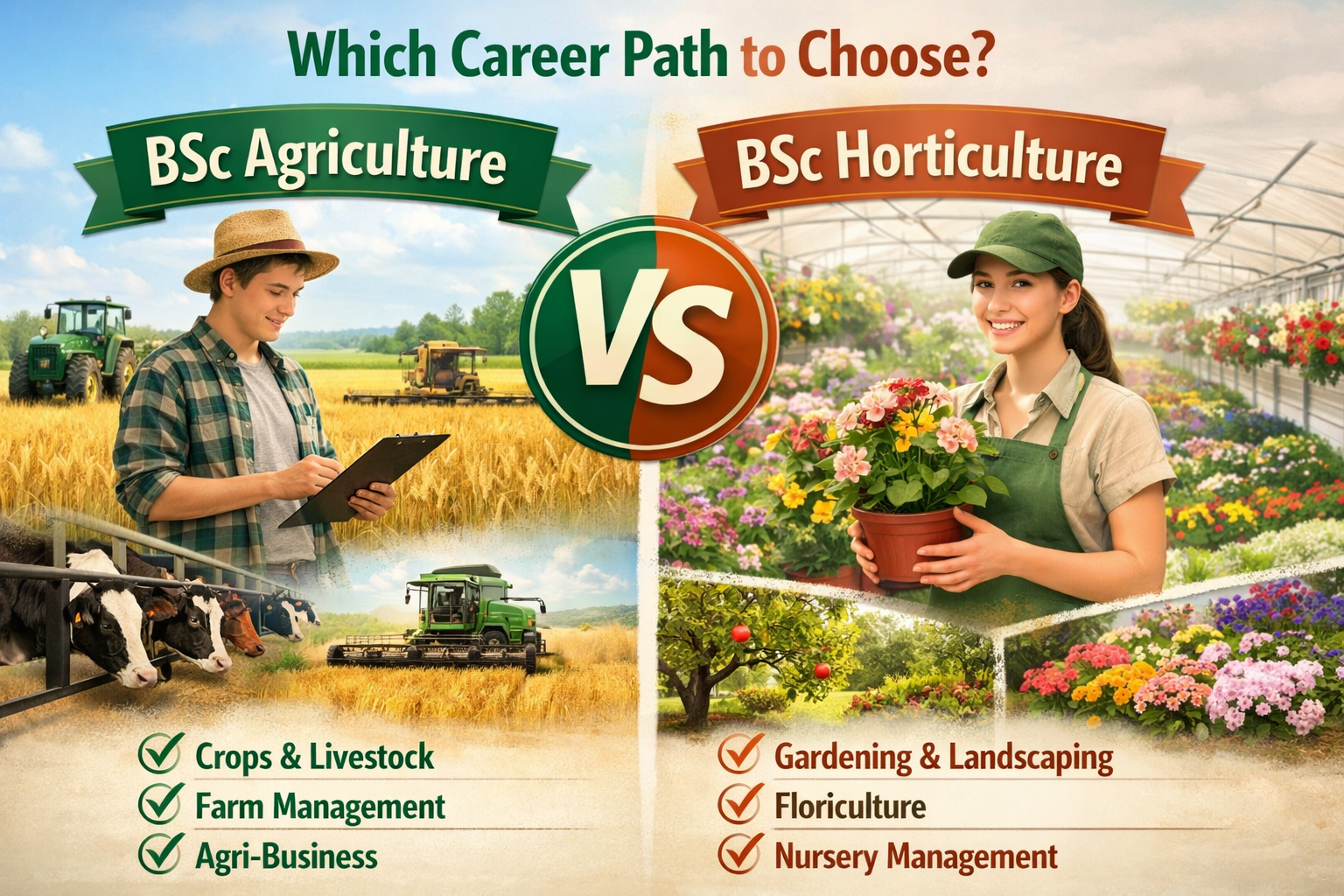
BSc Agriculture vs BSc Horticulture is an age-old comparison that students seek before seeking admission in the agricultural field. Both the courses are inter-related to each other and also provide good scope in India while the rise of food demand, focus on sustainability and expanding agribusiness has given importance to these studies in 2026. But they are not all created equal, and which you choose may be a function of what interests you, what your long-term goals are and how you like to work.
In this blog we are explaining the difference between BSc Agriculture and BSc Horticulture, career scope, job profiles, career growth and who must go for which course.
What is BSc Agriculture? Career options in BSc Agriculture
It is one of those degrees that if you lose passion for the subject, can still offer a broad range of career options. It specializes in agriculture and covers horticulture, soil science, plant breeding, economic sociology, work on the economics of animal husbandry and agronomy.
BSc Agriculture students learn about the operations of agriculture as a comprehensive system, from seed to market.
Some of most essential subjects in BSc Agriculture are:
- Crop production and agronomy
- Soil and water management
- Plant protection and pest control
- Agricultural economics and marketing
- Farm machinery and technology
- Agricultural extension and rural development
The course readies students for technical and management positions in the agriculture industry.
What is B.Sc Horticulture
BSc In Horticulture Horticulturure is a specialized course that targets fruits, vegetables, flowers, spices, plantation crops and medicinal and aromatic plantations. More technical and applied than general agriculture.
Those who major in horticulture are heavily involved with high-value plants and contemporary agricultural technologies.
Some of the main highlights of BSc Horticulture are:
- Fruit science and orchard management
- Vegetable production and protected farming
- Floriculture and landscaping
- Post-harvest management
- Nursery management and plant propagation
- Greenhouse and polyhouse farming
This course is perfect for those students who wish to deal with extensive production of commercial and high-income crops.
Key Difference Between BSc Agriculture and BSc Horticulture
Actually, the main contrast is either a broad vs depth.
B.Sc Agriculture:
- Touches all aspects of Farming
- Presents more government and administrative openings
- Appropriate for leadership, policy, and extension positions
B.Sc Horticulture:
- Focuses on specific high-value crops
- More practical and production-oriented
- Entrepreneurship, specialized farming
Depending on whether you are looking for a diverse role or a specific niche, the type of career should suit your preference.
Employment Opportunities After B.Sc Agriculture for 2026
Career in BSc Agriculture in 2026 is bright with government backing, food security concerns and agribusiness expansion.
Some of the popular options for career after BSc Agriculture are:
- Agricultural Officer
- Agribusiness Manager
- Agricultural Extension Officer
- Seed and fertilizer company executive
- Rural development professional
- Agricultural consultant
This degree also has numerous opportunities in various sectors like government jobs, banking, research and higher studies.
Job Prospects after BSc Horticulture in 2026
In such areas quality matter more than quantity, yield and value. What will you study in BSc Horticulture? As demand for fruits, vegetables and floriculture products increases, horticulturists are in much demand.
Careers after BSc Horticulture Some popular fields of employment for B.Sc Horticulture graduates are as follows:
- Horticulture Officer
- Orchard and plantation manager
- Floriculture and landscaping expert
- Nursery and greenhouse manager
- Post-harvest and cold storage specialist
- Horticulture entrepreneur
This degree is well suited for students who wish to have a hands-on job working with crops and production systems.
Government Jobs: Which Course Is Better?
There are government job opportunities available for both the degrees, but in terms of roles as well as a number of vacancies, BSc Agriculture scores more.
Job scope after doing BSc Agriculture The candidates who have completed their graduation in BSc agriculture have the following job prospects.
- Agricultural Officer posts
- Banking and NABARD roles
- UPSC and State PSC agriculture services 1.
- Teaching and research positions
What to do next after your BSc in Horticulture?
- Horticulture Officer posts
- State agriculture department roles
- Horticulture research institutes
- Government nurseries and farms
If civil service is what you aspire for, BSc Agriculture has wider birth eligibility.
Career Progress in the Private Sector and Corporate World
Now one size works in the private sector, both courses work well - but directly opposite to each other.
BAccSc or BSc Agriculture graduates should also apply if eligible for:?
- Agribusiness management roles
- Agri-input companies
- Sales, marketing, and operations
- Policy and consulting roles
Horticulture graduates, BSc
The bsc horticulture is the best option if a student has done this he /she can make their career easily in the field of agriculture.
- High-value crop production
- Export-oriented agribusinesses
- Food processing and cold chains
- Greenhouse and precision farming
Practical knowledge is also valued by private firms, so on-the-job training and exposure to the field are very important.
Entrepreneurship and Self-Employment Opportunities
If you have it in mind to strike out on your own, both courses present good opportunities.
BSc Agriculture graduates can start:
- Agribusiness startups
- Farm consultancy services
- Input supply businesses
- Farmer producer organizations
BSc Horticulture graduates can start:
- Organic farming units
- Nursery and planting material businesses
- Floriculture and landscaping services
- Fruit orchards and protected farming
Horticulture has a somewhat higher income potential from high value crops, however, it calls for more technical knowledge.
Higher Studies and Long-Term Growth
Both are types of degrees that enable a higher level education, which will boost career advancement.
After BSc Agriculture:
- MSc Agriculture
- MBA in Agribusiness
- PhD and research careers
After BSc Horticulture:
- MSc Horticulture
- Specialized crop research
- Teaching and academic roles
Advanced studies provide access to leadership, research and international opportunities.
Skills for Success in Both Professions
Whichever path you take, skill matters a great deal to success.
Important skills include:
- Practical field knowledge
- Communication and teamwork
- Business and market understanding
- Data and technology awareness
- Adaptability to new farming methods
Students who merge technical skills with business thinking are those who advance the most quickly.
Which Course Should You Opt for According to Your Interest?
Choose BSc Agriculture if:
- You want broad career options
- You value policy, management or administration
- You desire an option for flexible career switching
Choose BSc Horticulture if:
- You love working with plants and panicles.
- You wish to concentrate in fruits, vegetables, or flowers
- You intend to start a farm or nursery operation
- You gravitate toward work that is more hands-on and production-oriented.
What counts more than trends is your interest and frame of mind.
Conclusion
There is no one “better” way. The right choice is whichever serves your interests. BSc Agriculture is broad exposure and job flexibility whereas, BSc Horticulture provides better prospects with value addition options. In 2026, each area is much in demand and success depends on how well you wield your skills and seize opportunities.