
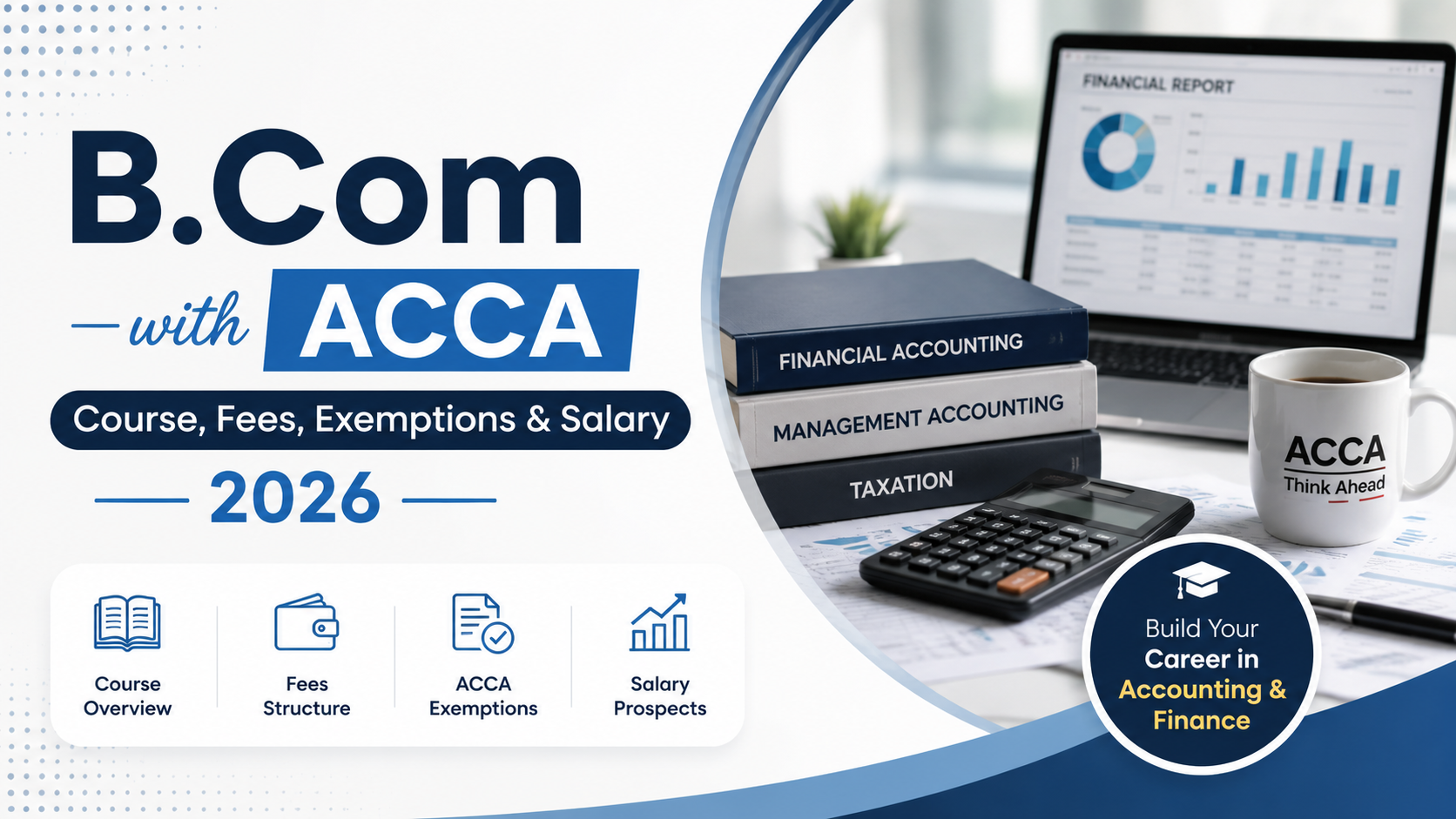
B.Com with ACCA: The Complete Guide to India's Most In-Demand Commerce + Global Accounting Combo
So far, considering between a conventional commerce degree or an internationally recognised professional qualification has meant deciding on one and postponing the other. With B.Com with ACCA, this trade-off is completely removed. Allows students to obtain a Bachelor of Commerce (B. Com.) degree that is recognised by UGC along with passing papers from the ACCA (Association of Chartered Certified Accountants )– a UK-based body that is ideally recognised in over 180 countries. The integrated route for commerce students aspiring to similar careers in either audit, taxation or through a finance path at MNCs and Big 4 Firms has rapidly grown to be one of the most searched as well as practical undergraduate pathways in India. Here's what you need to know before picking it.
What Is B.Com with ACCA?
The B.Com with ACCA is an undergraduate program of either 3 to 4 years full time that aligns the ACCA Knowledge modules onto the B.Com syllabus directly. Through an overlap with standard commerce students, financial accounting, taxation, auditing and business law are all covered in many traditional degrees and students can take up to nine of ACCA's 13 total papers by finishing their degree rather than studying for both credentials separately after graduation.
Why Students Choose B.Com over BBA for the ACCA Route
All the education counselors and previous students have always compared one thing, B.Com pairs more naturally with ACCA than BBA does.
Factor |
B.Com + ACCA |
BBA + ACCA |
|---|---|---|
| Subject overlap with ACCA | High — most papers are commerce-based | Lower — BBA is more theory/management-focused |
| Prep effort for ACCA papers | Lower, since coursework doubles up | Higher, needs separate focused study |
| Best suited for | Students set on finance/accounting careers | Students wanting broader business exposure |
ACCA Structure: What Gets Exempted
ACCA has 13 Papers over three levels :
- Applied Knowledge: 3 papers, largely covered by B.Com's first-year syllabus.
- Applied Skills: 6 papers, with significant overlap in second and third-year commerce subjects.
- Strategic Professional: 4 papers, generally completed after graduation.
Most of the B.Com + ACCA programs provide exemptions on the Applied Knowledge level and the Applied Skills level, which means, post-degree, only Strategic Professional papers need to be cleared, an effectively shorter route than starting out with ACCA from scratch.
Eligibility and Admission Process
- Should have scored a minimum of 50% in Class 12 (any stream; Commerce or Maths background is helpful but not essential).
- Many colleges additionally conduct their own entrance test or accept CUET scores, followed by a personal interview.
- Writing ACCA separately from the university along with the required registration fee.
Fees: What to Budget
- College Tuition: Cost of ₹1.5 lakh – ₹4 lakh for the full degree, depending on the institute.
- ACCA Examination Fee: ₹8,000 – ₹14,000 per paper (to be paid separately to ACCA).
- ACCA Registration and Examination Charges: Accommodate ₹80,000–₹1.2 lakh more over the span of the program for ACCA registration and examination charges
Career Scope and Salary After B.Com with ACCA
The graduates generally enter professions like financial accountant, internal/external auditor, tax consultant, business analyst and risk and compliance associate mainly in Big 4 firms (Deloitte, EY, KPMG or PwC), multinationals (MNCs) and financial institutions.
Initial Starting Salary in India: ₹4–8 LPA which grows upto ₹10–15 LPA as each year goes by and after getting a ACCA-affiliate too. As ACCA has international recognition, graduates also have a valid route to UK / Middle East / Singapore jobs without having to re qualify.
B.Com with ACCA vs. CA vs. CFA — Quick Take
- Select ACCA: If global mobility, quicker time to qualification, and GCC/UK-facing roles are your top priorities.
- Opt for CA: in case you are looking for the traditional Indian corporate finance or domestic Big 4 partnership tracks.
- Choose CFA: if you want to do investment analysis and portfolio management (i.e. working with clients directly) rather than audit/accounting.
Now, when a student in India pursues ACCA along with B.Com and then lays CA Inter on top of both & uses the two credentials together then it is not an alternative to each other.