
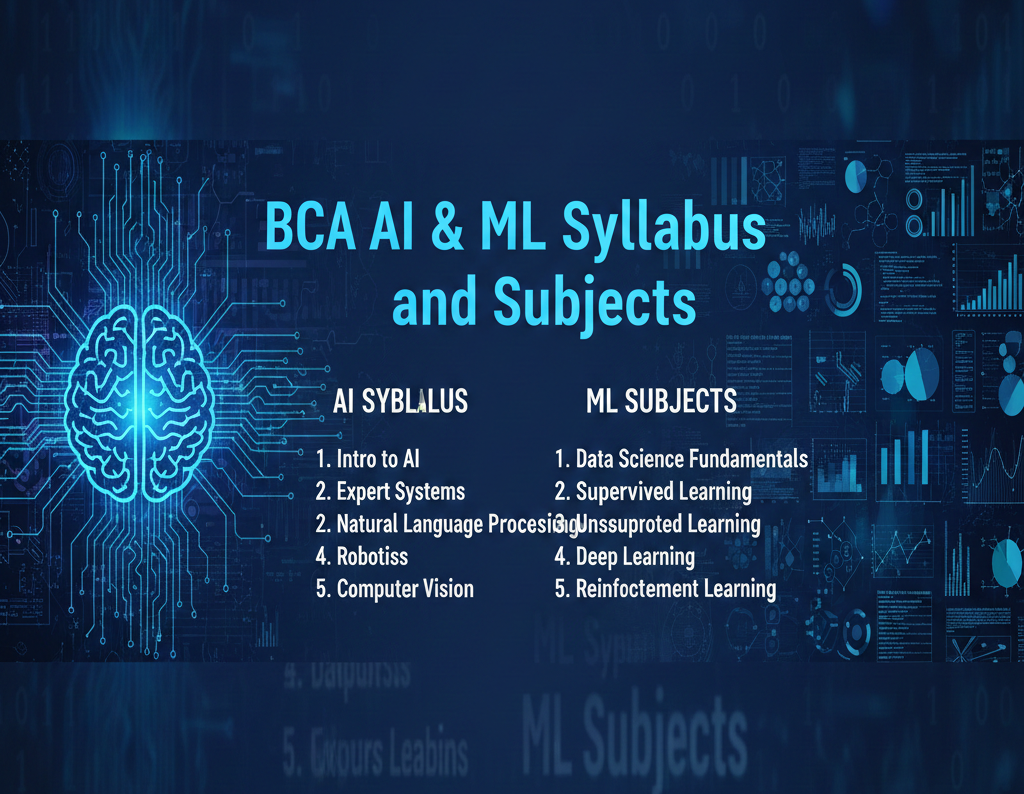
What if you could be part of the future that powers self-driving cars, intelligent chatbots and advanced data-driven decision-making? Artificial Intelligence and Machine Learning are not just buzzwords anymore; they are transforming every industry from healthcare to finance. For students who want to build a strong foundation in these technologies, pursuing a Bachelor of Computer Applications with a specialisation in AI and ML is an excellent choice.
In this article, you will find the complete BCA AI & ML syllabus and a clear breakdown of the BCA AI & ML course curriculum. This degree typically spans three years, divided into six semesters and is designed to equip students with both theoretical knowledge and practical skills in computer science, AI and machine learning. By the end of the programme, graduates are prepared to take on roles in technology-driven sectors where innovation and problem-solving are at the core.
The Complete BCA AI & ML Syllabus
To help you clearly understand how the programme is structured, here’s a semester-wise breakdown of the BCA AI & ML syllabus. Each year builds step by step, starting from computer fundamentals and moving towards advanced topics in artificial intelligence and machine learning. The table below is based on common patterns across multiple universities, but the exact sequence and electives may vary depending on the institution:
Year |
Semester |
Typical Subjects |
Labs / Projects |
|---|---|---|---|
| First Year | Semester 1 | Programming C / Python Mathematics / Discrete Mathematics Digital Logic / Computer Organisation English / Communication / Soft Skills | Foundation Programming Lab |
| Semester 2 | Data Structures Object-Oriented Programming Java / C++ Basic Statistics / Probability Environmental Studies / Value Education | Data Structures / OOP Lab | |
| Second Year | Semester 3 | Introduction to Artificial Intelligence, Database Management Systems, Operating Systems, Web Technologies | AI / ML Tools Lab / DBMS Lab |
| Semester 4 | Machine Learning Fundamentals, Algorithms, Computer Networks, Design and Analysis of Algorithms, Software Engineering | ML Algorithms Implementation Lab | |
| Third Year | Semester 5 | Deep Learning and Neural Networks, Big Data Analytics, Elective e.g. NLP IoT Cloud Computer Vision | Project Phase I / Industrial Training |
| Semester 6 | Data Mining and Warehousing, Ethics and AI / Data Privacy, Elective e.g. Robotics Blockchain, Final Major Project and Viva | Final Project & Presentation |
Key Components of the BCA AI & ML Course Curriculum
The BCA AI & ML course curriculum blends theory with practical learning, ensuring students gain both technical knowledge and industry-ready skills. Core areas include labs, projects, electives and internships that prepare graduates for real-world challenges.
Component |
Description |
Tools / Examples |
|---|---|---|
| Practical Learning & Labs | Emphasises hands-on experience with AI/ML tools and programming languages. | Python, R, TensorFlow, PyTorch, Jupyter Notebooks, Scikit-learn |
| Project-Based Learning | Involves mini-projects in earlier semesters and a major project in the final year to apply theoretical concepts to real-world problems. | Projects like chatbots, predictive analytics, image recognition systems |
| Elective Streams | Offers specialisation in areas such as Natural Language Processing, Computer Vision, Robotics, and Blockchain. | Electives tailored to emerging AI/ML domains |
| Industrial Internships | Provides opportunities for students to gain practical experience in AI/ML applications within industry settings. | Internships in tech firms, AI research labs, or data-driven enterprises |
Why Choose BCA in AI & ML?
Choosing a BCA in AI & ML gives students specialised knowledge in artificial intelligence and machine learning from the second year onwards, rather than sticking solely to general computer applications. This focused approach allows learners to gain practical skills and domain expertise that directly align with industry demands.
| Advantage | Details |
| Specialised Knowledge | From Year 2, students learn AI/ML concepts, algorithms, and tools unlike a traditional BCA which covers general programming and computer science fundamentals |
| Future Scope | Prepares graduates for high-demand roles such as Data Analyst, Machine Learning Engineer, AI Developer, and Big Data Specialist, giving a clear career path |
| Salary Potential | Entry-level salaries are often higher compared to general BCA graduates due to the niche skill set and industry relevance, providing a competitive edge |
This pathway equips students with both technical expertise and practical experience, positioning them strongly for advanced studies or immediate employment in emerging technology sectors.
Career Scope After BCA AI & ML
A BCA in AI & ML opens the door to a wide range of career opportunities in the rapidly growing fields of artificial intelligence, machine learning, and data analytics. Graduates gain skills that are highly sought after across IT, finance, healthcare, and research sectors.
Career Path |
Typical Job Roles |
Description |
|---|---|---|
Industry Roles |
Junior Data Scientist, ML Engineer Trainee, AI Developer, Business Intelligence Analyst | Work on real-world AI/ML projects, develop predictive models, automate processes, and contribute to data-driven decision-making |
Further Studies |
MCA, M.Sc. in Data Science, PG Diploma in Artificial Intelligence / Machine Learning | Advanced studies allow deeper specialisation, research opportunities, and better career prospects in niche AI/ML domains |
Conclusion
The BCA AI & ML syllabus provides a strong foundation in computer science while offering specialised skills in artificial intelligence and machine learning. From programming, mathematics, and core CS concepts to advanced AI/ML modules, hands-on labs, mini-projects, and electives, the BCA AI & ML course curriculum balances theory with practical application. Graduates are well-prepared for high-demand roles such as Junior Data Scientist, ML Engineer, AI Developer, and Business Intelligence Analyst, giving them a competitive advantage in the job market.
The programme also opens opportunities for further studies like MCA, M.Sc. in Data Science, or specialised PG Diplomas, helping students advance into senior positions. Electives and project-based learning allow exploration of areas like NLP, Computer Vision, Robotics, and Blockchain. Take the next step by exploring top institutions offering BCA in Artificial Intelligence and Machine Learning, or download a college-specific syllabus to plan your academic journey and secure a future-proof career in this rapidly growing field.
FAQs