

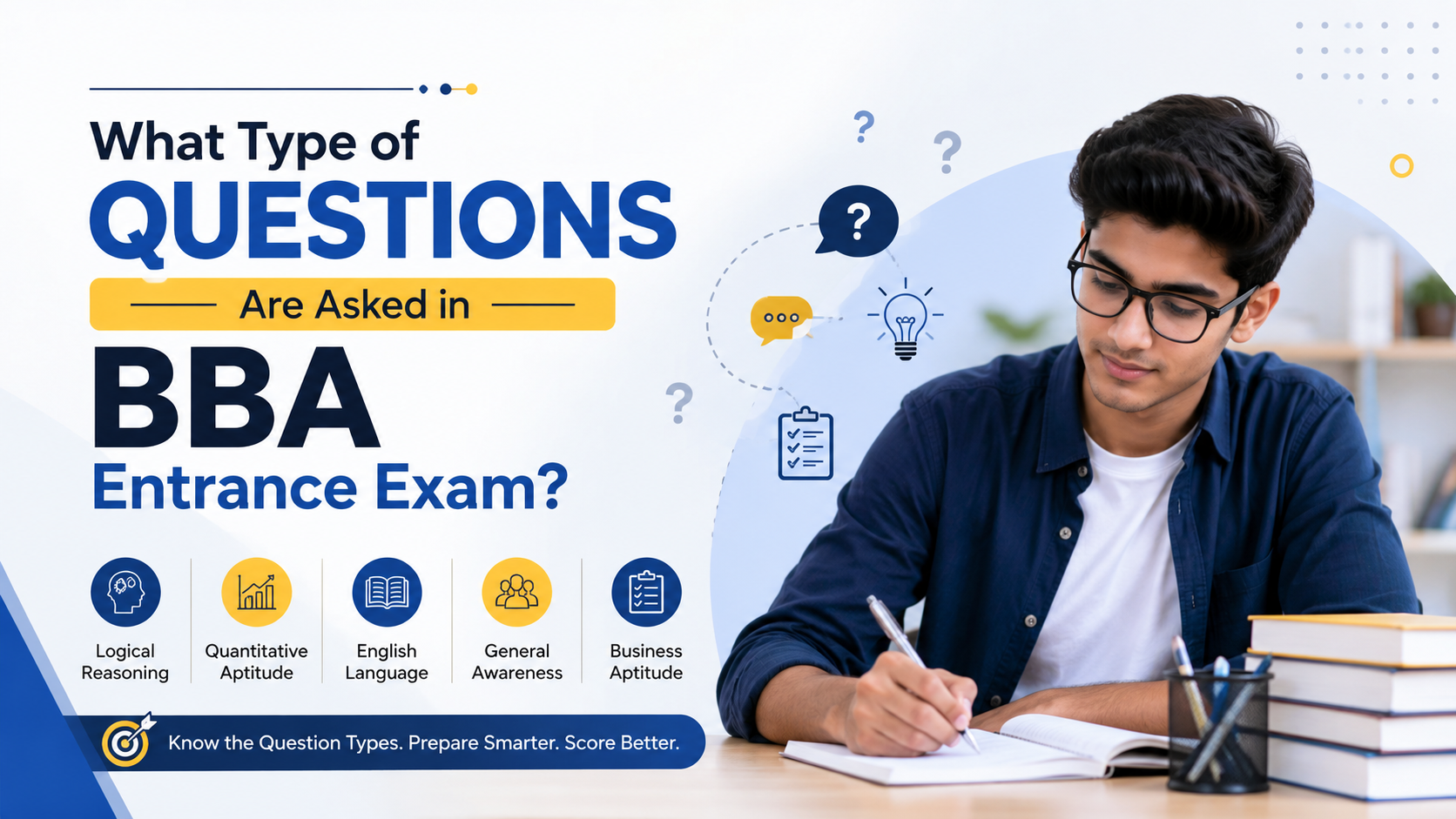
For aspiring students attempting a BBA entrance exam this year, the first and foremost thing that you need to know is not how do I study but what exactly will be asked. The bright side: Around 90% of BBA entrance tests in the country including SET, NPAT, IPMAT, CUET and other university level entrance tests would test you on these 4 broad areas. In this guide, we dissect each section, the kinds of questions you can expect and how to prepare efficiently.
The 4 Core Sections in Every BBA Entrance Exam
Objective multiple-choice based the most BBA entrance exams and are built around these four sections:
- Quantitative Aptitude / Numerical Ability
- English Language / Verbal Ability
- Logical and Analytical Reasoning
- General Knowledge / General Awareness (often with a business focus)
Many exams also have a fifth section on Data Interpretation or Computer Basics; however, the four above form 70% of every BBA entrance test.
Quantitative Aptitude Questions
This is a section where you test your Class 9–10 level maths, so it rewards fundamental understanding over advanced formulae. Common question types include:
Numbers are one of the most essential tools used by finance professionals to evaluate a company.
- Time, Speed and Distance
- Time and Work
- Simple and Compound Interest
- Number Series and Basic Algebra
- Data Interpretation: using bar graphs, pie charts, line charts and table, mostly asking to calculate the percentage change or growth rate or average from a dataset.
- Basic Geometry: Area, perimeter and other properties of triangles, circles and quadrilaterals
Class 12 Maths background students might require a little more practice here, but overall the difficulty level in most BBA exams ranges from easy to moderate.
English Language Questions
English usually has the highest component with 25–40% of marks as business requires good communication. Expect:
- Reading Comprehension: 300–600 words in a passage followed by questions including main idea, tone, inference and vocabulary contextual vocab (usually social sciences, economics or current affairs)
- Vocabulary: Synonyms, antonyms, and correct usage of words.
- Grammar: Error spotting, sentence correction, and sentence completion.
- Para Jumbles: Meant to rearranging jumbled sentences into a paragraph.
Logical and Analytical Reasoning Questions
This section tests how you think, not what you have memorized. Typical question types include:
- Series (number series, letter series, alpha-numeric series)
- Coding-decoding
- Blood relations and direction sense
- Syllogisms and statement-conclusion questions
- Seating arrangement and puzzles
- Analogies and classification (odd one out)
General Knowledge and Business Awareness Questions
This is also the part that students often underprepare for but it's also the section where you can build early wins with regular practice. Expect questions on:
- Current affairs (both national and international, of the previous 6–12 months)
- General business and economic vocabulary, major Indian and world companies, most recent business news
- Static GK – awards, books & authors, sports, days
- Government schemes and policy changes related to your business
Question Type Comparison Across Popular BBA Exams
Exam |
Sections |
Format |
Negative Marking |
|---|---|---|---|
| SET (Symbiosis) | Quant, English, GK, Reasoning | 60 questions, 60 minutes | No |
| NPAT (NMIMS) | Quant, Reasoning, Proficiency in English | MCQs, timed sections | No |
| IPMAT (IIM Indore/Rohtak) | Quantitative Ability, Verbal Ability (plus Short Answer) | MCQ + short-answer, varies by IIM | Varies |
| CUET (UG) | Domain subjects, General Test | MCQs | Yes (in most sections) |
| University-level exams (e.g., JUEE) | Quant, English, Reasoning, GK | MCQs, university-specific | Usually no |
Do keep checking the latest official pattern for your target exam, sections and marking schemes get revised most years.
How to Prepare: A Simple Section-Wise Approach
- Quant: revamp the basics of Class 9-10 every day, Set a timer for DI sets.
- English: read one editorial/business article every day to improve vocab and RC speed..
- Reasoning: one puzzle or series set a day (it is better to do it accurately than quickly here).
- Weekly Current Affairs: Develop the habit of reading current affairs on a weekly basis instead of learning it in one week before the examination.
- Mocks: do at least one complete mock a week in the last two months & examine every error.
Applying to BBA at JU Jaipur
Jagannath University Jaipur also offers a 3-years BBA course and for those students who are interested in law, they may also apply for the specialized 5-year BBA LLB. Admission is on the basis of Class 12 marks along with a valid score in the university's own entrance exam (JUEE) or CUET, therefore if you are targeting JU Jaipur then the above preparation strategy fits into your approach directly. The program is designed to create industry ready professionals with a hands-on approach of case studies, projects and placement assistance with the classroom learnt skills.
Ready to Take the Next Step?
Explore the BBA and BBA LLB programs at JU Jaipur and start your entrance exam preparation with a clear target in mind.