
What’s in store for civil engineers in a world ever under construction, reconstruction, and invention? Civil engineering has always been at the core of infrastructure, shaping everything from bridges and roadways to green cities and smart structures. For graduates with a B.Tech in Civil Engineering, the opportunities are anything but restricted.
There are many career opportunities after B.Tech Civil Engineering, some traditional, some new. Whether you want to build structures, direct large projects, or contribute to green sustainable development, there is so much in the industry. All jobs will challenge your technical capacity and enable you to make contributions to society. From core engineering positions to specialised roles, the range of career options in Civil Engineering is both vast and rewarding. This article highlights the top jobs after B.Tech Civil Engineering, helping you discover the most promising directions to shape your professional journey with confidence and clarity.
Why Should You Choose Civil Engineering as a Career?
Civil engineering goes beyond academics; it is about building the backbone of society. From roads and bridges to sustainable cities, the field offers strong career options, along with stability and growth, making it a truly rewarding choice.
-
Making a Lasting Impact
- Civil engineers design and build the infrastructure that society depends on, including roads, bridges, airports, dams, and hospitals
- The work leaves behind a tangible legacy that benefits communities for generations
- Few careers allow you to see such direct and long-term results from your efforts
-
Job Security and Stability
- With the global population constantly increasing, the demand for new and improved infrastructure remains strong
- This ensures steady career opportunities after B.Tech Civil Engineering and long-term job stability
- Skilled professionals are consistently required in both the public and private sectors
-
Diverse and Varied Work
- Civil engineering is far from monotonous, as it involves tasks ranging from site supervision and structural design to project management and data analysis
- Professionals collaborate with architects, urban planners, environmental experts, and government authorities, making the work highly dynamic
- The field offers top-tier education pathways with leading institutes like IIT Madras, IIT Roorkee, and NIT Tiruchirappalli, alongside reputed private universities such as BITS Pilani and Jagannath University, equipping students with world-class knowledge and training
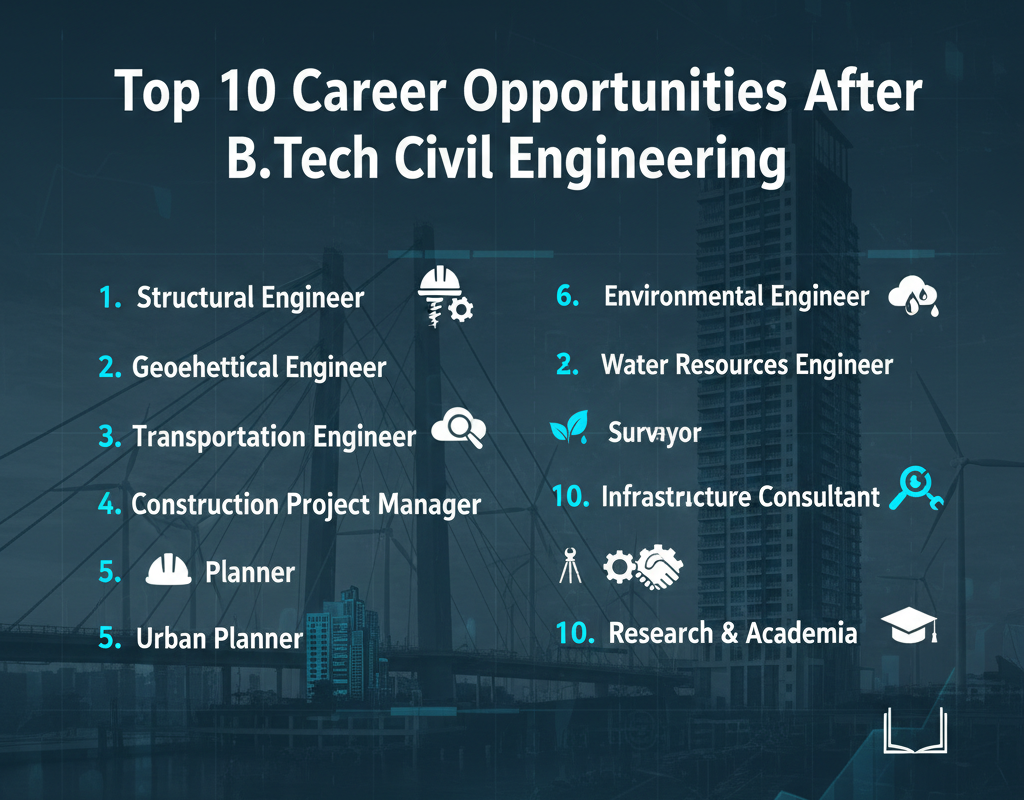
Top 10 Career Opportunities After B.Tech Civil Engineering
The field of civil engineering offers diverse opportunities for graduates, each with unique challenges and rewards. Whether in design, management, or sustainability, there are many jobs after B.Tech Civil Engineering that can lead to a successful career. The table below highlights the top career options in Civil Engineering with their roles, responsibilities, skills, and growth potential:
Career Path |
Role Description |
Key Responsibilities |
Required Skills |
Career Growth & Salary Potential |
|---|---|---|---|---|
Structural Engineering |
Focuses on the design and analysis of buildings, bridges, and other structures | Analysing designs using tools like STAAD.Pro, ensuring safety and stability | Strong knowledge of structural analysis, problem solving, proficiency in design software | High demand in construction firms and consultancies with excellent long-term growth |
Geotechnical Engineering |
Deals with soil and rock mechanics for construction projects | Conducting site investigations, designing foundations, managing risks related to ground conditions | Soil mechanics expertise, analytical skills, fieldwork experience | Stable career in infrastructure and tunnelling projects with competitive salaries |
Transportation Engineering |
Plans, designs, and maintains transport systems | Working on roads, railways, airports, and transit systems to improve flow and safety | Planning, data analysis, traffic simulation software skills | Growing opportunities in smart city projects and government initiatives |
Construction Management |
Oversees construction projects from start to finish | Project planning, budgeting, scheduling, and team coordination | Leadership, project management tools, budgeting skills | Offers managerial growth with lucrative salaries in large-scale projects |
Environmental Engineering |
Develops solutions for environmental challenges | Projects on pollution control, waste management, and sustainable systems | Knowledge of environmental laws, sustainability focus, technical expertise | Rising demand due to focus on green and sustainable infrastructure |
Water Resources Engineering |
Manages water-related systems and resources | Designing dams, irrigation systems, water supply networks | Hydrology, hydraulics, analytical and design skills | Strong prospects in government projects and sustainability-focused industries |
Urban Planning |
Shapes the growth and development of cities | Designing and implementing urban plans, working with agencies and the public | Spatial planning, GIS tools, communication skills | Increasing demand with rapid urbanisation and smart city projects |
Design Engineer (CAD/BIM) |
Creates technical drawings and digital models | Developing blueprints and 3D models using AutoCAD, Revit, BIM tools | CAD/BIM software proficiency, creativity, attention to detail | Consistent demand in consultancies, architecture, and design firms |
Project Management |
Focuses on leadership and business aspects of projects | Managing project lifecycles, budgets, and timelines | Leadership, communication, project management certifications like PMP | High salary potential with growth into senior management roles |
Site Engineer |
Supervises on-site construction activities | Ensuring projects meet design specifications and safety regulations | Practical problem solving, site supervision, teamwork | Essential role in all projects with steady career growth |
Alternative Career Options in Civil Engineering
Not all career options in Civil Engineering are limited to traditional roles on construction sites or design offices. Many graduates are now exploring non-traditional paths that are equally rewarding and offer unique growth opportunities. From technical consultancy to real estate development, research, and government jobs, these alternatives allow civil engineers to apply their skills in diverse and impactful ways.
Career Path |
Role Description |
Key Responsibilities |
Required Skills |
Career Growth & Salary Potential |
|---|---|---|---|---|
Technical Consultant |
Provides expert advice to clients on engineering projects | Assisting with technical challenges, optimising designs, solving project-specific issues | Problem solving, strong technical knowledge, communication skills | High demand in consultancy firms with potential for senior advisory roles |
Real Estate Development |
Applies engineering expertise to property development and management | Planning and managing construction projects, analysing feasibility, overseeing development | Project management, market understanding, budgeting | Growing sector with opportunities to advance into senior developer or management positions |
Research & Academia |
Engages in higher education, research, and teaching | Conducting studies, publishing papers, teaching students, supervising projects | Analytical skills, research methodology, teaching abilities | Stable career in universities and research institutions with scope for PhD-level advancement |
Government Sector |
Works in public sector units (PSUs) and government departments | Planning and implementing infrastructure projects, policy implementation, regulatory compliance | Technical expertise, understanding of government procedures, project management | Excellent job security and steady career growth with attractive benefits |
Future Trends in Civil Engineering Careers
The field of civil engineering is evolving rapidly, creating exciting opportunities for graduates who are ready to adapt and innovate. Emerging career options in Civil Engineering are increasingly shaped by sustainability, technology, and urban development.
-
Sustainable and Green Infrastructure
- Growing emphasis on reducing environmental impact is driving demand for engineers skilled in eco-friendly materials and energy-efficient designs
- Professionals are working on zero-waste construction methods and sustainable building practices that benefit both society and the planet
-
Smart Cities and Urbanisation
- Rapid urban growth and connected cities require civil engineers to design and implement smart infrastructure
- Opportunities include developing integrated public transit systems, smart grids, and data-driven urban planning to enhance the quality of life
-
Integration of Technology
- New technologies are reshaping traditional workflows and creating high-tech roles in the industry
- Building Information Modelling (BIM), drones for site inspection, 3D printing in construction, and AI for project optimisation are becoming essential skills for modern civil engineers
Key Skills to Succeed in the Job Market
Success in civil engineering requires a balanced mix of technical expertise, soft skills, and a commitment to continuous learning. Developing the right skill set can open doors to the best jobs after B.Tech Civil Engineering.
-
Technical Skills
- Proficiency in engineering software like AutoCAD, STAAD.Pro, Revit, and Civil 3D
- Strong foundation in structural analysis, geotechnical studies, transportation planning, and construction management
- Understanding of modern construction methods and sustainable engineering practices
-
Soft Skills
- Problem-solving and critical thinking to tackle complex project challenges
- Effective communication and teamwork for collaborating with diverse stakeholders
- Leadership and project management skills to oversee projects from concept to completion
-
Certifications and Upskilling
- Earning certifications in Building Information Modelling (BIM), project management (PMP), and sustainable construction practices can enhance career prospects
- Continuous learning in emerging technologies ensures civil engineers remain competitive and ready for evolving industry demands
Conclusion
There is a wide and diverse range of career opportunities after B.Tech Civil Engineering, from traditional roles like structural and transportation engineering to modern paths in sustainability, smart cities, and technology-driven projects. Graduates have access to numerous jobs after B.Tech Civil Engineering that match different interests and skill sets, whether in design, management, consultancy, or research.
As the industry continues to evolve with emerging technologies, green infrastructure, and global challenges, choosing the right career options in Civil Engineering depends on your personal strengths, passions, and long-term goals. Embracing continuous learning and staying updated with modern practices like BIM, AI, and sustainable construction will ensure a fulfilling and successful career.
FAQs