

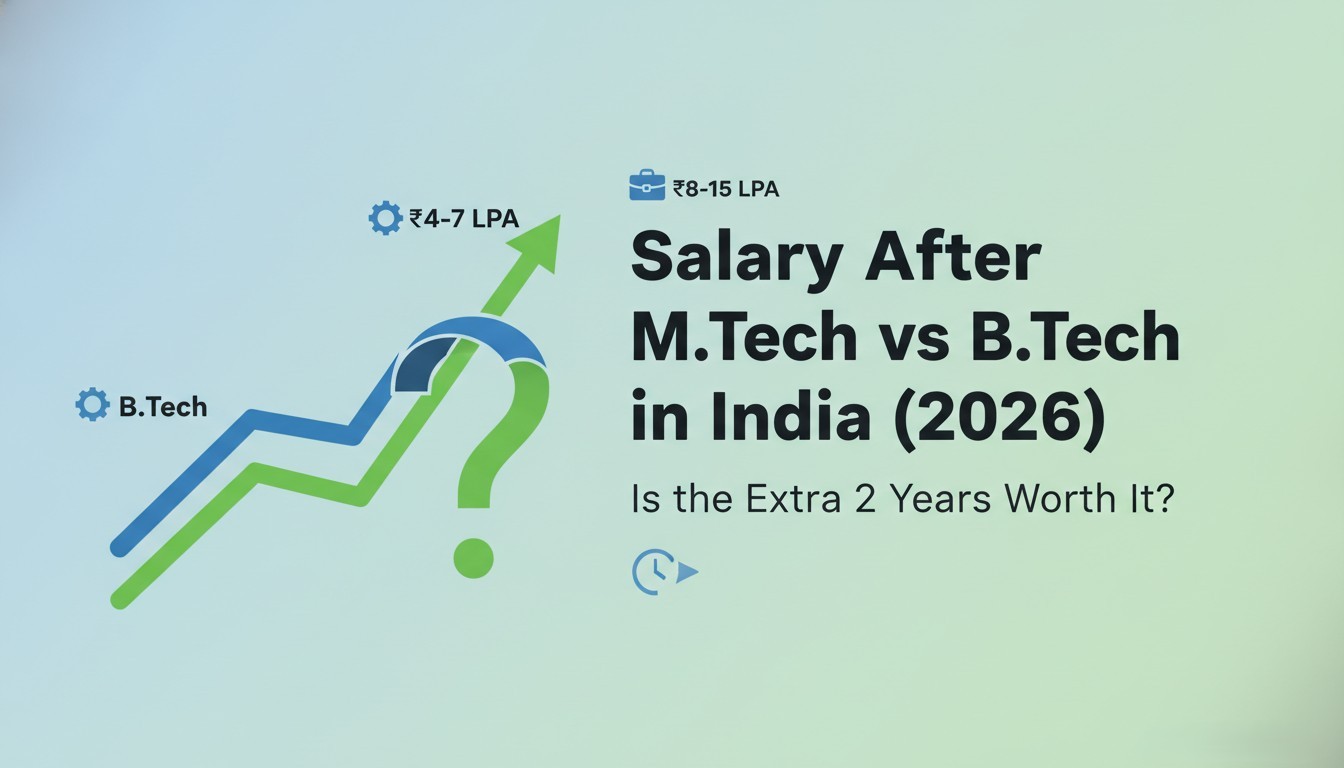
Salary After M.Tech vs B.Tech in India (2026): Is the Extra 2 Years Worth It?
After B.Tech, every engineering student has one big dilemma whether to enter the job market or continue with studies for another two years in M.Tech
The answer isn't one-size-fits-all. The answer depends on branch, career goal, industry you want to enter and which college are you taking M tech from. But salary is usually the most important concern and with good reason.
In this post, we dissect the real-world salary figures for B.Tech and M.Tech graduates (2026) in India branch-wise, and help you determine if an M.Tech ROI makes sense or not.
B.Tech Salary in India 2026: What to Expect as a Fresher
B.Tech graduates, when joining the Indian job market can expect salaries between ₹3 LPA to ₹12 LPA based on branch, college and company.
Average B.Tech Fresher Salary by Branch |
|
|---|---|
Branch |
Average Starting Salary (LPA) |
| CSE / IT | ₹4 – ₹12 LPA |
| ECE | ₹3.5 – ₹8 LPA |
| Mechanical Engineering | ₹3 – ₹6 LPA |
| Civil Engineering | ₹3 – ₹5.5 LPA |
| Electrical Engineering | ₹3.5 – ₹7 LPA |
IITs and NITS get much higher packages that belong to top-level engineering colleges. The maximum B.Tech CSE placement package was ₹1.28 crore (international offer) for 2026-27, while ECE students have been paid up to ₹74 LPA at the best colleges.
But for most of the private college graduates, getting something between ₹3.5 LPA and ₹6 LPA is reality as their starting salary.
M.Tech Salary in India 2026: The Post-PG Premium
The added technical specialisation that comes with the M.Tech helps aspirants gain a sizeable salary advantage over B.Tech freshers on many fronts.
Freshers M.Tech from general private colleges ₹4 LPA - ₹8 LPA In contrast, recipients of degrees from IITs, NITs & IISc regularly net packages in Software, Data science & AI roles that are ₹10 LPA-₹25 LPAs +.
Average M.Tech Salary by Branch (2026)
Branch |
Fresher Salary Range |
Top Company Packages |
|---|---|---|
M.Tech CSE / AI / Data Science |
₹6 – ₹20 LPA | ₹25 LPA+ (MAANG) |
M.Tech ECE / VLSI |
₹5 – ₹12 LPA | ₹15 LPA+ |
M.Tech Mechanical / Aerospace |
₹3.5 – ₹8 LPA | ₹12 LPA (PSUs) |
M.Tech Civil Engineering |
₹3.5 – ₹7 LPA | ₹10 LPA |
M.Tech Electrical / Power Systems |
₹4 – ₹10 LPA | ₹12 LPA (PSUs) |
The average M.Tech salary in India is ₹22.7 LPA (aggregated from placement data) and the median stands at around ₹19.5 LPA (as of 2023). Remember that these numbers are extremely driven by IIT/NIT placements plus jobs in hot tech.
M.Tech vs B.Tech Salary: Head-to-Head Comparison
Here's a side-by-side comparison to put the numbers next to each other:
Parameter |
B.Tech (Fresher) |
M.Tech (Fresher) |
|---|---|---|
| Average Starting Salary | ₹3 – ₹6 LPA | ₹4 – ₹8 LPA |
| Top College Starting Salary | ₹10 – ₹20 LPA | ₹10 – ₹25 LPA |
| Salary Advantage | Baseline | ~20–30% higher* |
| PSU / Govt Roles | Available | Preferred / Higher grade |
| R&D / Research Roles | Limited | Widely available |
| Teaching (Assistant Professor) | Not eligible | Eligible (with NET/PhD) |
In core engineering domains, M.Tech seats have been found to take the largest share of starting salary (~20–30% increase over B.Tech graduates for similar roles). The gap can be higher or lower, based on skills and projects, from our experience in IT/software roles.
When M.Tech Is Worth It: 4 Scenarios
You Want to Work in Core Engineering (PSUs, R&D, Defence)
PSUs such as BHEL, ONGC, ISRO and many more publicly owned by state-operated enterprises or providers urgently seek postgraduate engineers and are offering perks ranging from ₹8 lakh per year (LPA) to ₹12 LPA to M.Tech holders. M.Tech graduates who are GATE-qualified also receive stipends (in government funded institutes, this is up to ₹12,400/month) for at least half of the program duration.
You're Aiming for an IIT/NIT M.Tech
An M.Tech from a top-tier institute is a genuine career accelerator. IIT M.Tech placements frequently see packages of ₹15 LPA to ₹30 LPA in software and product companies levels that most B.Tech graduates from average colleges take years to reach.
You Want to Become a Faculty or Enter Research
For most departments at the University level or to pursue a PhD, an M.Tech (most times with NET/GATE) is required. Not Optional: If you are looking towards academia or research, M. Tech is not an option, it becomes the only way forward.
You're in a Niche High-Demand Field (AI, VLSI, Cybersecurity)
Specialized branches of M.Tech in Artificial Intelligence, Machine Learning, VLSI Design, and Cybersecurity are in strong demand in 2026. A postgraduate qualification in these areas is often a requirement for industry roles and, therefore, the salary differential over B.Tech can be as high as 40% or more.
When B.Tech Is Enough (And M.Tech May Not Be Worth It)
In Software / IT Companies
This is the key point of contention. Many companies do not differentiate between B.Tech and M.Tech salary at the time of hiring in India's booming IT sector including top product companies. Oftentimes, it is what you can do instead of the level of your degree.
At premium product companies and startups, a skilled B.Tech graduate with strong DSA, system design, and real-world projects can match or exceed an M.Tech graduate's package. Some institutes, like IIIT Allahabad, reportedly even saw B.Tech packages outpacing M.Tech offers in certain placement cycles.
If You Have 2+ Years of Work Experience
Two years of substantial industry experience usually gives greater returns on investment than two years of M.Tech particularly in software, marketing-tech, analytics and product management. A B.Tech person who did those years was able to develop skill and portfolio and can earn more than many M.Techs.
If You're Going to an Average Private College
In case of M.Tech, pursuing it from a low ranked private college seldom compensates for the opportunity cost. Even if they have quality placement, great industry connections and good research set up, not more than 2 to 3 lakhs of salary uplift can be obtained by the B.Sc. holder than a normal B.Tech holder sometimes no raise at all compared with B.tech holder.
The Opportunity Cost Equation
That is the calculation that most students fail on.
Factor |
Amount |
|---|---|
| M.Tech course duration | 2 years |
| Average B.Tech salary you'd forgo | ₹4 – ₹5 LPA × 2 = ₹8 – ₹10 lakhs |
| M.Tech fees (private college) | ₹3 – ₹8 lakhs |
| GATE stipend (if applicable) | -₹2.5 – ₹3 lakhs savings |
| Total opportunity cost | ₹9 – ₹15 lakhs |
M.Tech should solely be justified in a financial sense, that is – your M.Tech degree should fetch you at least ₹5 -₹7 LPA more on an annual basis compared to your combined offer from only a B.Tech. If you are an IIT/NIT M.Tech graduate from CSE/VLSI/AI finally it's easy math for most. However, for private college M.tech in mechanical or civil engineering, it would be a tighter ROI.
Regardless of the degree, here are the most important factors which are seen to influence your salary.
Key Factors That Affect Your Salary — Regardless of Degree
- Institution Reputation — Graduates from IIT, NIT, and IIIT are still generally better compensated than those from many private colleges.
- Demand for Specialisation — CSE, AI/ML, and VLSI are among the highest-paying specialisations in the private sector, while Civil and Mechanical Engineering typically offer comparatively lower salaries.
- Location — Major technology and employment hubs such as Bengaluru, Hyderabad, Pune, Mumbai, and Delhi NCR often provide higher salary opportunities.
- Certifications — AWS, GCP, Python, and TensorFlow certifications add market value for both B.Tech and M.Tech graduates.
- Internships and Projects — Practical experience gained during or after the course can accelerate career growth and salary progression.
- GATE Score — A strong GATE score can open pathways to PSU recruitment and admission to top M.Tech programs, both of which can significantly increase earning potential.
Conclusion
The most honest answer: it depends on what you want and where you will study.
Definitely, if you are targeting IIT/NIT M.Tech in CSE or any of the cream technical fields — salary increase and career opportunities as well as research makes it really a worthwhile trip.
M.Tech is almost necessary if you want to land a PSU job, R&D role or pursue an academic career.
But if you are going for an average private college for M. Tech, and want a software job in IT—then think twice. The opportunity cost is real: Two years of experience in the industry plus upskilling might do you better.
Nevertheless, your investments are best made, anywhere: in your skill set, in the quality of your projects & GATE preparation — after all a great M.Tech experience is only as great as the institute you enter.