

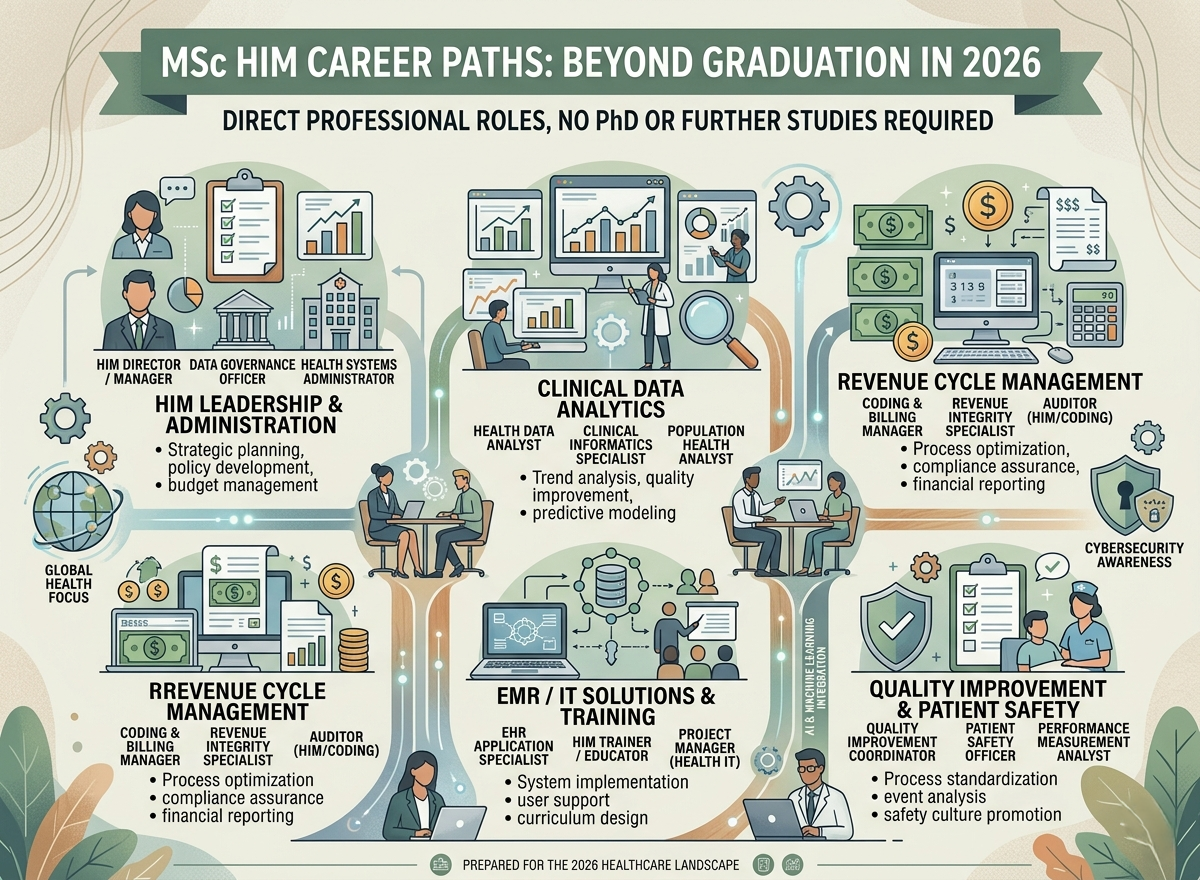
MSc HIM Career Paths Without PhD or Further Studies in 2026
Many think that after they finish MSc Health Information Management (MSc HIM), the only way their career could be rewarding is by working for their PhD, starting a new course, etc. But not in 2026.
The Boom of Digitalistation in Health makes that graduates have career opportunities that may lead to a high-growth without PhD or other studying further than masters. Today's healthcare organizations find technical skills, systems knowledge and experience in clinical settings to be far more important than research-based advanced degrees.
This blog discusses the best careers after MSc HIM without PhD or any additional studies with job roles, skillset needed and career prospects.
Why MSc in Health Informatics Graduates Will Not Require a PhD In 2026
With the advancements in technology, the healthcare sector has moved from a human-centered world to a tech-driven and operation-centric realm. Here is what employers seek for the well-rounded professional:
- Manage digital health records
- Handle healthcare data securely
- Support IT systems and analytics
- Ensure compliance and quality
Many of these jobs don’t require research experience. What they need is industry ready candidates, something that MSc HIM graduates are.
Health Information Analyst
Health Information Analyst: Health Information Analyst is one of the sought out career after MSc HIM.
What the role involves:
- Analyzing patient and hospital data
- Preparing healthcare performance reports
- Supporting management decisions
- Ensuring data accuracy and consistency
Why this role is ideal:
This position is focused on utilizing data, not pursuing academic research, and therefore ideal for graduates who wish to join the workforce sooner rather than later.
EHR (Electronic Health Records) Specialist
The EHR specialists are an important sector in the digital hospitals as well as health-tech companies.
Key responsibilities:
- Managing electronic patient records
- Assisting doctors and employees in navigating EHR software
- Maintaining data quality and workflows
- Coordinating with IT teams
Career advantage:
Nearly all hospitals are utilizing EHR systems, so demand for EHR experts is steady and increasing.
Medical Coding Auditor
Medical coding is an excellent non-academic career.
What this role includes:
- Reviewing medical codes for accuracy
- Ensuring proper documentation
- Supporting billing and compliance teams
- Reducing claim rejections
Why it works without PhD:
This position is looking for coders and compliance personnel, not research.
Healthcare Data Quality Manager
Good quality data are essential for making informed decisions in healthcare.
Job responsibilities:
- Monitoring data accuracy and completeness
- Improving documentation standards
- Supporting audits and accreditations
- Training staff on quality practices
Growth potential:
With experience, they can advance to senior management positions without additional education.
Health IT Project Coordinator
Healthcare IT projects need an ecosystem of technicians and analysts who know technology and workflow.
What you’ll do:
- Support system implementation
- Track project timelines
- Ensure smooth digital transitions
Why MSc HIM grads are a good fit:
They also comprehend clinical data and the IT processes of a hospital, making them perfect to be coordinators.
Clinical Data Manager
Clinical data managers collaborate with medical professionals and research groups.
Key Duties:
- Managing clinical databases
- Ensuring data integrity
- Supporting reporting requirements
- Maintaining compliance standards
Why no PhD is needed:
This position is for operation and management, not research.
Healthcare Compliance Officer
Compliance officers have a duty to see that hospitals comply with healthcare laws.
Role Responsibilities:
- Monitoring data privacy practices
- Ensuring adherence to healthcare laws
- Conducting internal audits
- Training staff on compliance
Career Benefit:
Trust and longevity Compliance functions are high-trust roles, which means that they’re positions suitable for a longer term.
Health Informatics Executive
What this role involves:
- Managing digital health systems
- Supporting telemedicine platforms
- Improving data interoperability
- Assisting digital transformation initiatives
Why it’s future-ready:
This is a role that marries tech with day-to-day health operations, not a research or academic position.
Insurance and Claims Analyst
MSc in HIM Representation: Insurance Medical insurance companies engage MSc HIM graduates to serve as analysts.
Responsibilities include:
- Reviewing medical claims
- Ensuring correct coding and documentation
- Reducing fraud and errors
- Supporting claim approvals
Why this career is practical:
Roles in insurance are around process efficiency and data analysis, nothing further.
Healthcare Consultant (Entry-Level)
Support positions in MSc HIM consulting firms are available.
What you’ll do:
- Analyze healthcare processes
- Prepare reports and presentations
- Support digital health projects
- Assist senior consultants
Growth scope:
More experienced professionals can advance to senior consultant positions without a PhD.
Skills of the Future: 10 Skills You’ll Need to Thrive in 2026
To succeed or for advancement without education, MSc HIM graduates should concentrate on:
- EHR and HIS system knowledge
- Healthcare data analytics
- Medical coding standards
- Data privacy and compliance
- Communication and coordination skills
- Problem-solving abilities
These skills are also in demand, industry-valued and job-focused.
What companies are hiring MSc HIM grads with no PhD
Graduates can work in:
- Multi-specialty hospitals
- Healthcare IT companies
- Health-tech startups
- Insurance firms
- Diagnostic centers
- Telemedicine platforms
- Global healthcare BPOs
These fields are all about skills and experience, not research.
Salary Growth Without Further Studies
Career Development Is Based on Skills and Experience:
- Entry-level roles offer stable salaries
- Skilled professionals see fast increments
- Highest paying jobs are analytics and IT duties
- Stability for years to come at senior operational levels
There are many leaders who do not have PhD.
Careers After MSc HIM in 2026
There is great promise for the future due to:
- Digital healthcare expansion
- Growing health-tech startups
- Increased data security needs
- Global demand for HIM professionals
- Rise of AI-supported healthcare systems
HIM MSc graduates who concentrate on hands-ons skills will continue to be in strong demand.
Conclusion
A Masters in Health Information Management in 2026 is more than enough qualification to still guarantee a successful, well-paying and stable career – without a PhD or extra degrees.
Organizations are now favoring real-world experience, system knowledge and digital skills. With a strong career trajectory and ongoing skill building, MSc HIM graduates can aspire to leadership positions and lasting professional success.