

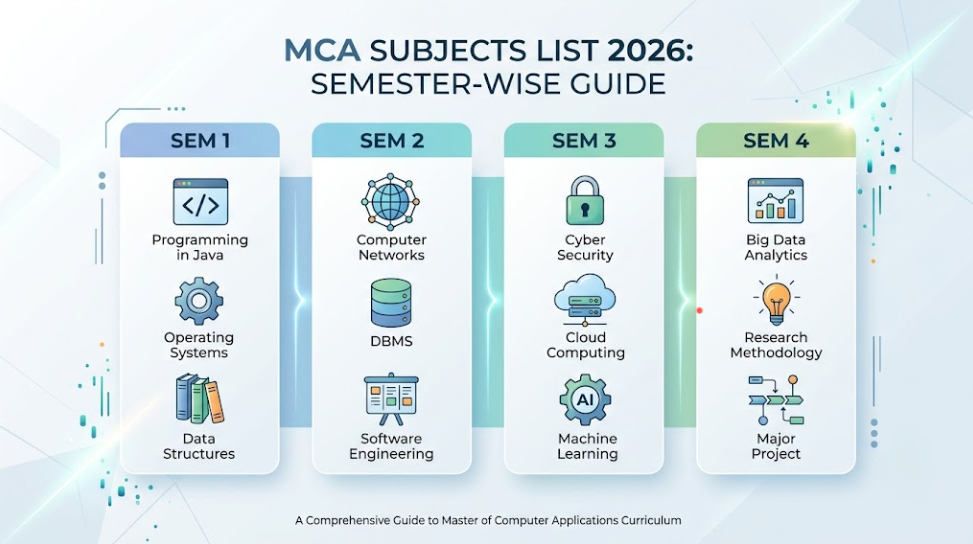
Master of Computer Applications (MCA) is a 2-Year, UGC/AICTE approved postgraduate programme with 4 semesters and focuses on programming and mathematics fundamentals in semester 1 while progressing to specializations like AI, cybersecurity, cloud computing given during semester 4.
The Master of Computer Applications (MCA) has 30+ subjects in total distributed across 4 semesters. Sem 1–2 are your core (programming, DBMS, data structures, computer networks and os). Semesters 3–4 are dedicated to electives and specializations (AI/ML, Cloud Computing, Cyber Security, Data Science) with a final-semester project or internship.
MCA Subjects List 2026: Semester-Wise Breakdown
Semester |
Focus Area |
Core Subjects |
|---|---|---|
Semester 1 |
Programming & Math Foundations | Programming in C/Python, Discrete Mathematics, Computer Organization & Architecture, Database Management Systems, Digital Logic Design |
Semester 2 |
Data & Systems | Data Structures & Algorithms, Object-Oriented Programming (Java), Operating Systems, Software Engineering, Computer Networks |
Semester 3 |
Advanced Computing + Electives | Design & Analysis of Algorithms, Web Technologies, Cloud Computing, Mobile Application Development, elective 1 (AI/ML, Data Science, or Cybersecurity) |
Semester 4 |
Specialization + Project | Advanced elective (Cybersecurity, IoT, or Big Data Analytics), Research Methodology, Major Project/Dissertation, Industry Internship |
Semester 1 MCA Subjects
Foundation of Mathematics and Programming programming skills — year 1 is probably the most foundational subject, because everything that comes later depends upon this subject.
- Programming Fundamentals (C or Python)
- Discrete Mathematical Structures
- Computer Organization and Architecture
- Database Management Systems (DBMS)
- Digital Logic Design
- Programming Lab
Semester 2 MCA Subjects
Semester 2 transitions from basic concepts to the data-and-systems layer upon which software development ultimately relies.
- Data Structures and Algorithms
- Object-Oriented Programming with Java
- Operating Systems
- Software Engineering
- Computer Networks
- DSA and OOP Lab
Semester 3 MCA Subjects
This is the point where the program begins to branch off into the applied and elective territory.
- Design and Analysis of Algorithms
- Web Technologies (HTML/CSS/JavaScript or some frameworks)
- Cloud Computing
- Mobile Application Development
- Elective 1: often AI & ML, Data Science or Cybersecurity
Semester 4 MCA Subjects
The last semester revolves around depth of specialization and a capstone project.
- A high-level elective: Cybersecurity, Internet of Things (IoT), or Big Data Analytics
- Research Methodology
- Major Project / Dissertation
- Industry Internship (in many colleges this runs concurrently with or in place of a classroom elective)
Popular MCA Electives and Specializations
Most colleges make their Master of Computer Applications (MCA) different from each other through electives. Specialization tracks most common, include:
- Artificial Intelligence & Machine Learning
- Data Science
- Cybersecurity
- Cloud Computing
- Internet of Things (IoT)
Exact elective names and the electives available at a certain college differ, so it is worth confirming a specific institute's basket before solidifying your decision.
MCA Practical and Lab Subjects
An MCA course is a combination of theory papers and lab components associated with the core subjects for each semester – programming lab in semester 1, DSA/OOP lab in semester 2, web or cloud labs along with database tools like MySQL or Oracle and BI tools such as Power BI or Tableau as electives progress into hands-on practice.
MCA Eligibility for 2026 Admission
- 10+2 or graduation with Mathematics as one of the subjects commonly from BCA, B.Sc. Computer Science, or B.Com with Math).
- Minimum aggregate marks as per university criteria (generally 50 % thus, can be lowered according to the university for reserved categories.)
- Certain colleges have written entrance examinations or accept national/state-level scores (NIMCET) along with merit-based admittance