
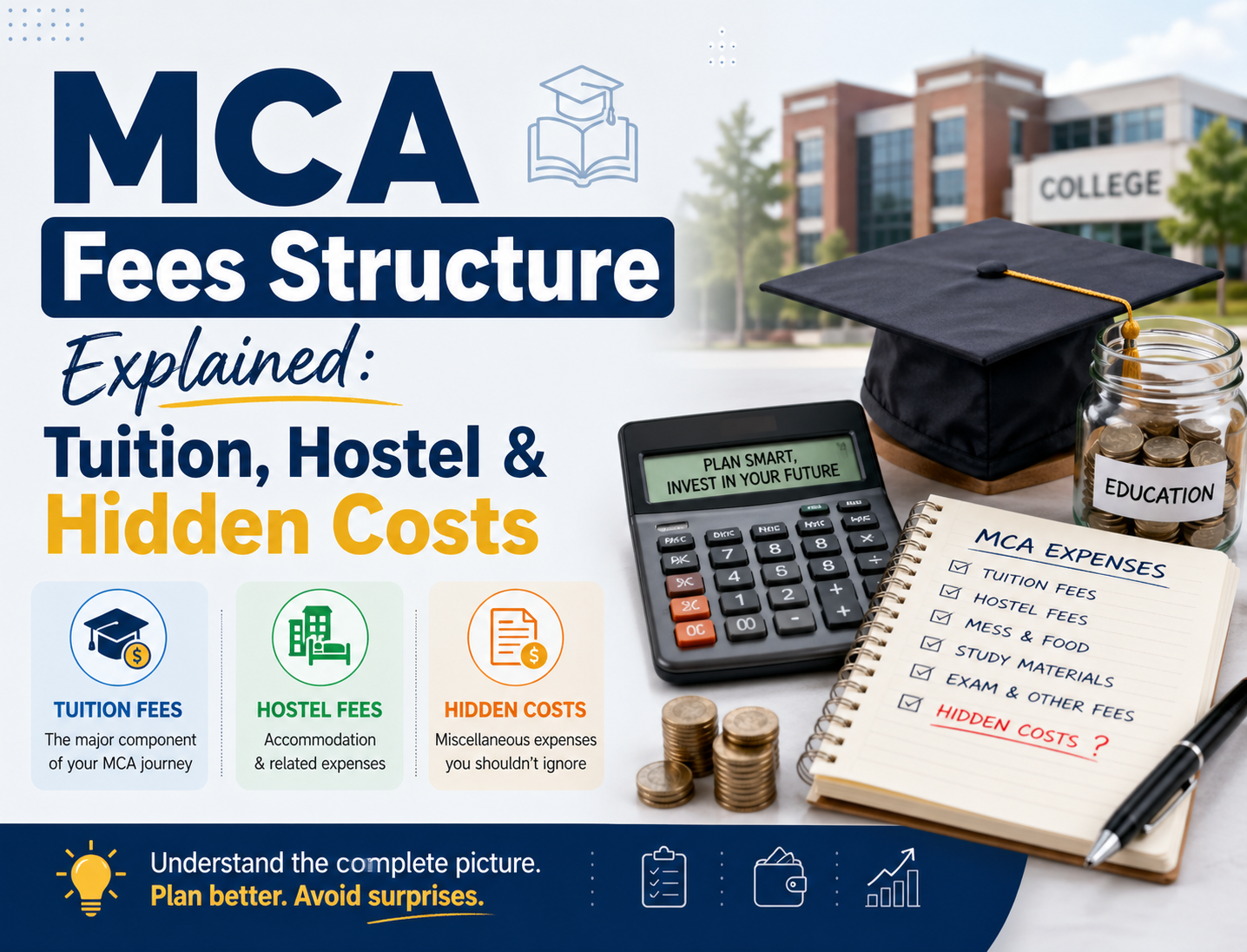
MCA Fees Structure Explained: Tuition, Hostel & Hidden Costs
If you're planning to pursue an MCA degree, one of the first questions that comes to mind is — how much will it actually cost? The answer is not straightforward. MCA course fees in India vary widely depending on the type of college, city, and additional charges that most students don't account for upfront.
This guide breaks down everything — tuition, hostel, mess, and the costs nobody talks about — so you can plan your finances without any surprises.
What Is the Fee Range for MCA in India?
The MCA course fee in India starts from as low as ₹20,000 per year at government colleges and can go up to ₹3,00,000 or more per year at top private and deemed universities.
Here's a quick overview:
- Government Colleges and NITs: ₹20,000 – ₹80,000 per year
- Private Colleges (Mid-Range): ₹80,000 – ₹1,50,000 per year
- Deemed and Premium Private Universities: ₹1,50,000 – ₹3,00,000+ per year
Most MCA programs are now 2 years (4 semesters) following the NEP 2020 reform. Some older universities still run the 3-year format, so always confirm the duration before comparing fees.
Admission Open for MCA degree 2026 Apply Now
Government College vs Private College: Fee Difference
The type of institution makes the biggest difference in what you'll pay. Government-funded colleges and NITs have subsidised fees, while private universities charge based on their brand, infrastructure, and placement record.
Annual tuition fees:
- Government / NIT: ₹20,000 – ₹80,000
- State Private College: ₹60,000 – ₹1,50,000
- Deemed / Premium Private: ₹1,50,000 – ₹3,00,000+
Hostel charges per year:
- Government / NIT: ₹15,000 – ₹40,000
- State Private College: ₹40,000 – ₹80,000
- Deemed / Premium Private: ₹80,000 – ₹1,50,000
Exam and lab fees per year:
- Government / NIT: ₹3,000 – ₹8,000
- State Private College: ₹8,000 – ₹18,000
- Deemed / Premium Private: ₹10,000 – ₹25,000
One important point — private colleges often advertise a lower "base tuition" and charge separately for development fees, IT infrastructure, placement support, and industry visits. Always ask for a head-wise fee breakup before paying the admission deposit.
MCA Tuition Fee: Semester-Wise Breakdown
MCA fees are usually charged per semester. Here's what you can expect across 4 semesters:
Government / NIT colleges:
- Semester 1 & 2: ₹10,000 – ₹35,000 each
- Semester 3 & 4: ₹10,000 – ₹40,000 each
- Total (2 Years): ₹40,000 – ₹1,50,000
Mid-range private colleges:
- Semester 1 & 2: ₹35,000 – ₹70,000 each
- Semester 3 & 4: ₹35,000 – ₹80,000 each
- Total (2 Years): ₹1,45,000 – ₹3,00,000
Premium private / deemed universities:
- Semester 1 & 2: ₹70,000 – ₹1,40,000 each
- Semester 3 & 4: ₹75,000 – ₹1,60,000 each
- Total (2 Years): ₹2,90,000 – ₹6,00,000
Most colleges also charge a one-time admission or registration fee at joining — around ₹1,000 to ₹5,000 at government colleges and ₹5,000 to ₹25,000 at private institutions.
Hostel, Mess & Living Expenses
For students coming from another city, hostel and living costs often end up being more than the tuition itself. Here's a realistic monthly and yearly breakdown:
- Hostel Room Rent (On Campus): ₹2,000 – ₹10,000/month | ₹18,000 – ₹90,000/year
- Mess / Food Charges: ₹2,000 – ₹5,000/month | ₹18,000 – ₹45,000/year
- PG or Off-Campus Room: ₹5,000 – ₹15,000/month | ₹50,000 – ₹1,35,000/year
- Groceries and Eating Out: ₹1,500 – ₹4,000/month
- Transport and Commute: ₹500 – ₹2,000/month
- Electricity and Internet: ₹300 – ₹800/month
If your college is in a metro city like Bengaluru, Pune, or Delhi, living costs will be 40 to 60 percent higher than a Tier-2 city. A student living off-campus in Bengaluru can easily spend ₹15,000 to ₹20,000 per month on rent alone.
Also note — on-campus hostel seats are limited, especially at private colleges. If you don't get a hostel seat, you'll need to budget for a PG which costs significantly more.
Hidden Costs Nobody Mentions
This is the section most college brochures skip. Here are the additional charges that frequently catch MCA students off guard:
- Development or Building Fund: ₹10,000 – ₹50,000 per year. Charged by most private colleges for infrastructure maintenance.
- Examination and Re-Evaluation Fees: ₹1,500 – ₹8,000 per semester. University exam registration charges are often separate from tuition.
- Library and IT Lab Fees: ₹2,000 – ₹12,000 per year. Not always included in the quoted tuition amount.
- Placement and Training Fees: ₹5,000 – ₹30,000 (one time or annual). Some colleges charge for access to their placement cell.
- Industry Visits and Study Tours: ₹3,000 – ₹15,000. Often made mandatory as part of the curriculum.
- Books, Stationery and Software: ₹5,000 – ₹20,000 per year. Includes textbooks, licensed tools, and project-related expenses.
- Convocation and Alumni Fee: ₹2,000 – ₹8,000. A one-time charge collected near graduation.
- Caution Deposit (Refundable): ₹5,000 – ₹20,000. Collected at admission and refunded after completing the program.
Some private colleges also charge a "smart class" or "e-learning" fee of ₹8,000 to ₹20,000 per year for access to their LMS platform. This is rarely disclosed upfront. Always ask for the complete list of fee heads before committing.
Total Cost of MCA: Realistic 2-Year Estimate
Here's what a complete MCA program will likely cost you, all-inclusive:
Government / NIT colleges:
- Tuition: ₹40,000 – ₹1,50,000
- Hostel + Mess: ₹60,000 – ₹1,40,000
- Hidden and Miscellaneous: ₹20,000 – ₹50,000
- Personal and Travel: ₹40,000 – ₹80,000
- Estimated Total: ₹1,60,000 – ₹4,20,000
Mid-range private colleges:
- Tuition: ₹1,50,000 – ₹3,00,000
- Hostel + Mess: ₹1,40,000 – ₹2,50,000
- Hidden and Miscellaneous: ₹50,000 – ₹1,20,000
- Personal and Travel: ₹60,000 – ₹1,20,000
- Estimated Total: ₹4,00,000 – ₹7,90,000
Premium private / deemed universities:
- Tuition: ₹3,00,000 – ₹6,00,000
- Hostel + Mess: ₹2,50,000 – ₹4,00,000
- Hidden and Miscellaneous: ₹1,00,000 – ₹2,00,000
- Personal and Travel: ₹80,000 – ₹1,50,000
- Estimated Total: ₹7,30,000 – ₹13,50,000
Admission Open for MCA Program 2026 Apply Now
Scholarships and Financial Aid for MCA Students
There are several practical options to reduce what you pay out of pocket:
- National Scholarship Portal (NSP): Central Government scholarships for SC, ST, OBC, and EWS students covering full or partial tuition at approved institutions.
- AICTE Pragati and Saksham Scholarships: AICTE runs Pragati for female students in technical education and Saksham for students with disabilities. MCA qualifies under both.
- State Government Scholarships: Most states have their own schemes. Check your state education department's portal each year for updated eligibility.
- Merit-Based Institutional Scholarships: If you score well in NIMCET or CUET-PG, many private colleges offer partial fee waivers. Negotiation during admission is possible.
- Education Loans from PSU Banks: SBI Student Loan, Canara Bank Vidya Turant, and similar schemes offer up to ₹7.5 lakh without collateral. Repayment begins after course completion plus a one-year moratorium.
- Vidyalakshmi Portal: A single window for education loan applications across multiple banks. Visit vidyalakshmi.co.in before admission.
Tips to Keep Your MCA Fees and Expenses Under Control
- Crack NIMCET or CUET-PG: A good rank helps you secure admission in an NIT or central university at much lower fees, saving ₹4 to ₹8 lakh over two years.
- Choose a Tier-2 City College: Living costs in metro cities are 40–60% higher, while many Tier-2 colleges offer comparable academic quality.
- Stay in Campus Hostel: On-campus accommodation is usually 50–70% cheaper than off-campus PG options. Apply early as seats fill quickly.
- Ask for a Written Fee Schedule: Before paying the admission deposit, request a detailed fee structure for all 4 semesters. Verbal commitments are not reliable.
- Apply for Education Loans Early: PSU bank interest rates (8.5–9.5%) are lower than private NBFC loans (12–14%). Apply 2–3 months before joining.
- Start Freelancing by Semester 2: Many MCA students earn ₹10,000 to ₹25,000 per month through freelance or remote work, helping cover living expenses.