

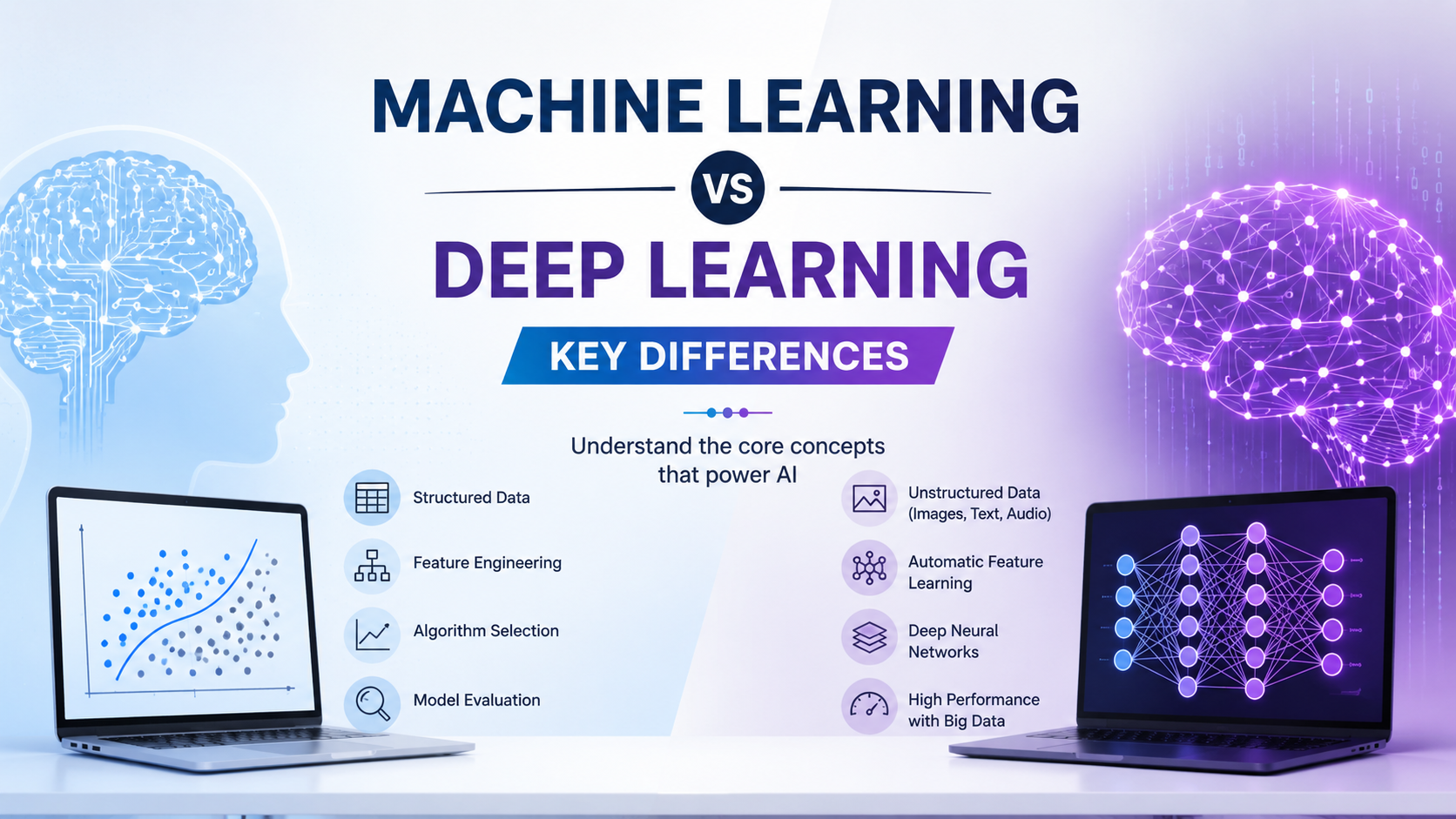
"Deep learning, isn't it just a deeper type of machine learning? That's a good question and the answer is yes, but that one-line explanation conceals a lot of practical differences that can be an important consideration if you're deciding what to study, which career direction to pursue, or which approach best matches the project you are working on."
This guide explains in a very stepwise manner the difference between Machine Learning (ML) and Deep Learning (DL), what is each actually used for and which one to learn first.
The Core Difference in One Line
Machine Learning is the greater domain of algorithms that will learn from patterns in data. Deep Learning is a special case of Machine Learning which applies a multi-layered neural network to automatically learn those patterns without having humans manually design the features.
Which is like saying: all Deep Learning is Machine Learning, but not all Machine Learning is Deep Learning.
How They Actually Work
Machine Learning
Traditional ML algorithms depend significantly upon feature engineering: a human decides what features the model should focus on. Common algorithms include:
- Linear and Logistic Regression
- Decision Trees and Random Forests
- Support Vector Machines (SVM)
- k-Nearest Neighbours (k-NN)
- Gradient Boosting (XGBoost, LightGBM)
They are useful in structured tabular data and do not require very large datasets to generalise well.
Deep Learning
Deep Learning employs a class of differential neural networks (the deep because there are layers with hidden units) that learn features from raw data, pixels, full audio waveforms or "raw text" without any manual feature engineering. Common architectures include:
- Convolutional Neural Networks: For images and video
- RNNs / LSTMs: Recurrent Neural Networks — when to use it: we can identify sequential data
- Transformers: For language and more and more vision, audio, etc.
Key Differences at a Glance
Factor |
Machine Learning |
Deep Learning |
|---|---|---|
Data requirement |
Works well with smaller datasets | Needs large volumes of data to perform well |
Feature engineering |
Manual, done by a human expert | Automatic, learned by the model |
Hardware needs |
Runs fine on standard CPUs | Usually needs GPUs/TPUs for training |
Training time |
Faster to train | Slower, more compute-intensive |
Interpretability |
Generally easier to explain | Often a "black box," harder to interpret |
Best suited for |
Structured/tabular data | Unstructured data (images, text, audio) |
Example use cases |
Credit scoring, churn prediction, fraud detection | Face recognition, voice assistants, language models |
Where Each One Is Actually Used
Machine Learning in the Real World
- Banks: Credit risk scoring, fraud detection on transactions
- E-commerce Use Case: Personalized recommendation engines based on purchasing history
- Marketing: Customer churn prediction, lead scoring
- Healthcare: Predicting the likelihood of patient readmission from structured records
Deep Learning in the Real World
- Artificial Intelligence: Face recognition, analysis of medical images, perception in self-driving cars
- Natural Language Processing: Chatbots, translation, huge language models like the ones behind contemporary AI assistants.
- Speech: Voice assistants, speech-to-text transcription
- Generative AI: Image generation, code generation, content creation tools
Which One Should You Learn First?
For starters, the first topic to master is Machine Learning. Here's why:
- The math is more approachable. If you want to understand deep learning instead of just using it as a black box, then ML concepts such as regression and decision trees provide the statistical groundwork in this regard.
- You will get knowledge of essentials: The bias-variance tradeoff, overfitting, evaluation metrics, common for both fields.
- Deep learning is an extension of ML concepts. Overall neural networks represent an application of the same basic optimisation ideas (gradient descent, loss functions) we use in classical ML.
- Deep Learning is often an overkill for real-world business problems. When facing typical business use cases, an ML model tuned properly on the structured data often overtakes a neural network and is also much more explainable to stakeholders.
A Practical Way to Decide (For a Specific Project)
Ask these three questions:
- What type of data do I have? Structured/tabular → ML. With respect to images, text, audio and video → DL is typically more suitable.
- How much data do I have? Small to medium data set → ML usually works better and there's less chance for overfitting. Huge dataset → DL extracts more performance.
- Shall I explain what the model is doing? If interpretability is important (such as, for example, in the case of a loan approval decision), ML models are typically much easier to rationalize before regulators or stakeholders.
Final Thoughts
Machine Learning and Deep learning are not two competing approaches. Deep Learning is a specialised branch of the broader ML field, built for solving large-scale problems related to unstructured data. All the rest being equal, for most learners and almost all kinds of business problems starting with Machine Learning fundamentals primes you with a good base to use both techniques, as well as discovering which one actually fits the problem standing in front of your eyes.