

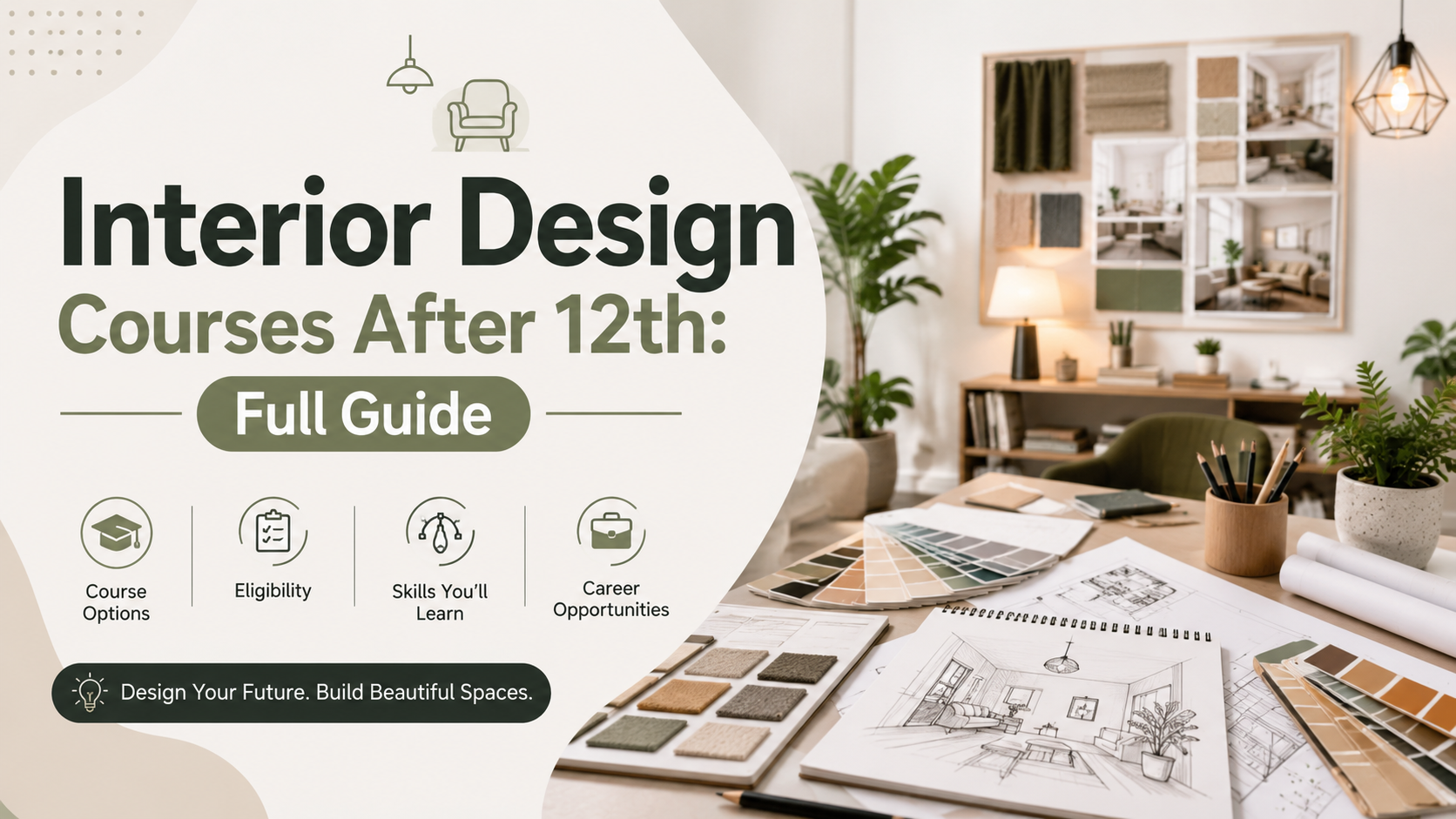
If you sketch out whatever room comes to mind, get a kick out of rearranging rooms in your home now and then, or have an eye for choosing colour palettes purely for fun, interior design could be more than just a hobby; it might be your career. The steady demand is fuelled by India's booming real estate, hospitality and retail sectors.The good news is you can embark on the journey to a career in interior design courses after 12th. This post is about Best Interior Design Courses after 12th, Entrance Exams to get in, Eligibility, Fees and Salary offered.
What Are Interior Design Courses After 12th?
Interior design is about creativity blended with technicality which includes space planning, material selection, lighting and digital tools like CAD and 3D visualization are all part of the mix as well. With that being said, after Class 12 students have the option of taking up few different course paths based on how deep they want to dive:
- B.Des in Interior Design: consists of 4 years undergraduate degree which is the actual and extensive process recognized by industry.
- Bachelor in Interior Design: a 3 year science-based full-time degree designed in an extended fashion compared to B.Des principles aimed largely at design.
- Diploma/Advanced Diploma in Interior Design: Short courses (of 1 or 2 years), useful for a smooth entry into the field.
- BA in Interior Design: Offered by a few Universities blending traditional design theory with creative arts.
The B.Des is broadly preferred over all of these as part of other placements, and especially realistic career prospects further down the line as it teaches design basics along with intensive studio work.
Top Entrance Exams for Interior Design After 12th
Because institutions look at creativity and design aptitude rather than an academic mark alone, Design courses in India are almost always entrance based. Key exams include:
- NID DAT (National Institute of Design Admission Test): National Entrance Exam for Design is one of the most popular & competitive entrance exams in India.
- UCEED (Undergraduate Common Entrance Examination for Design): Conducted by IITs (Indian Institutes of Technology). It is accepted by IIT Bombay and other leading design schools.
- NIFT Entrance Exam: NIFT exam only for fashion but some interior/ design also by few institutes secondary
- University-Level Entrance Examinations (JUEE or Others): a lot of the private universities will conduct their own design aptitude test, and may be followed by a portfolio review or personal interview.
Many of these tests assess drawing and sketching ability, spatial visualization, creativity, and general design awareness — all skills that can be honed through practice rather than studying.
Eligibility Criteria for Interior Design Courses
Broad eligibility across most institutions:
- 12th Pass in Any Stream—Science, Commerce or Arts from a recognized education board
- The minimum aggregate marks generally fluctuate from 45%-60% depending on the institute.
- A score(s) in the design entrance exam of your relevance
- Many programs also require a portfolio submission or personal interview to assess design sensibility
Interior Design Course Fees in India
Fees differ enormously depending on the kind of institution and location:
- Top design institutes (NID, top private design schools): ₹3–8 lakh per year.
- B.Des programs from universities: Approximately ₹1–2 lakh per annum.
- Diploma courses: Typically cost less than ₹1 lakh for the entire program.
Be sure to compare the overall course price, not just the first year, studio access and software licenses as well as material costs can escalate individually at some schools.
Career Scope and Salary After Interior Design
There are a broad array of sectors that an interior design degree can make you eligible for the roles of:
- Residential Design: Working for homes and apartments.
- Commercial Design: Offices, retail stores and malls, maintaining a balance between brand identity & utility
- Hospitality Design: Deals mainly with Hotels, Resorts, Restaurants focusing on the ambience and guest experience.
- Set and Exhibition Design: for events, films, and trade shows.
- Independent Consultant: most designers will at some point branch out on their own into either a studio or freelance.
Salary expectations in India (2026)
Role |
Typical Starting Salary (per annum) |
|---|---|
| Junior Interior Designer | ₹3–6 lakh |
| Space Planner | ₹3–5 lakh |
| Furniture/Product Designer | ₹3.5–6 lakh |
| Design Consultant (3+ years) | ₹6–12 lakh |
| Independent Practice/Studio Owner | Variable, scales with client base |
A good portfolio, specialization (in sustainable or luxe interiors) and experience of working across residential, commercial and even hospitality projects will all deliver meaningful salary growth.
Key Skills You'll Build
- Space planning and spatial visualization
- CAD, 3D modeling and rendering software (AutoCAD, SketchUp, Revit)
- Material and lighting specification
- Sustainable and green design principles
- Client communication and project management
Studying Interior Design at JU Jaipur
This B. Des (Interior Design) offered at Jagannath University Jaipur is a perfect blend of design fundamentals and technical training that involves CAD, 3D visualization and digital rendering. Applicants are admitted based on Class 12 scores (50% in any stream) and the University Entrance Examination (JUEE) and interview/portfolio review. The program offers studio training, workshops and live projects in association with design firms along with classroom learning plus involvement and mentorship by practitioners of architecture and design within the course structure.
Ready to Start Your Design Career?
Explore the B. Des (Interior Design) program at JU Jaipur and take the first step toward turning your creativity into a career.