

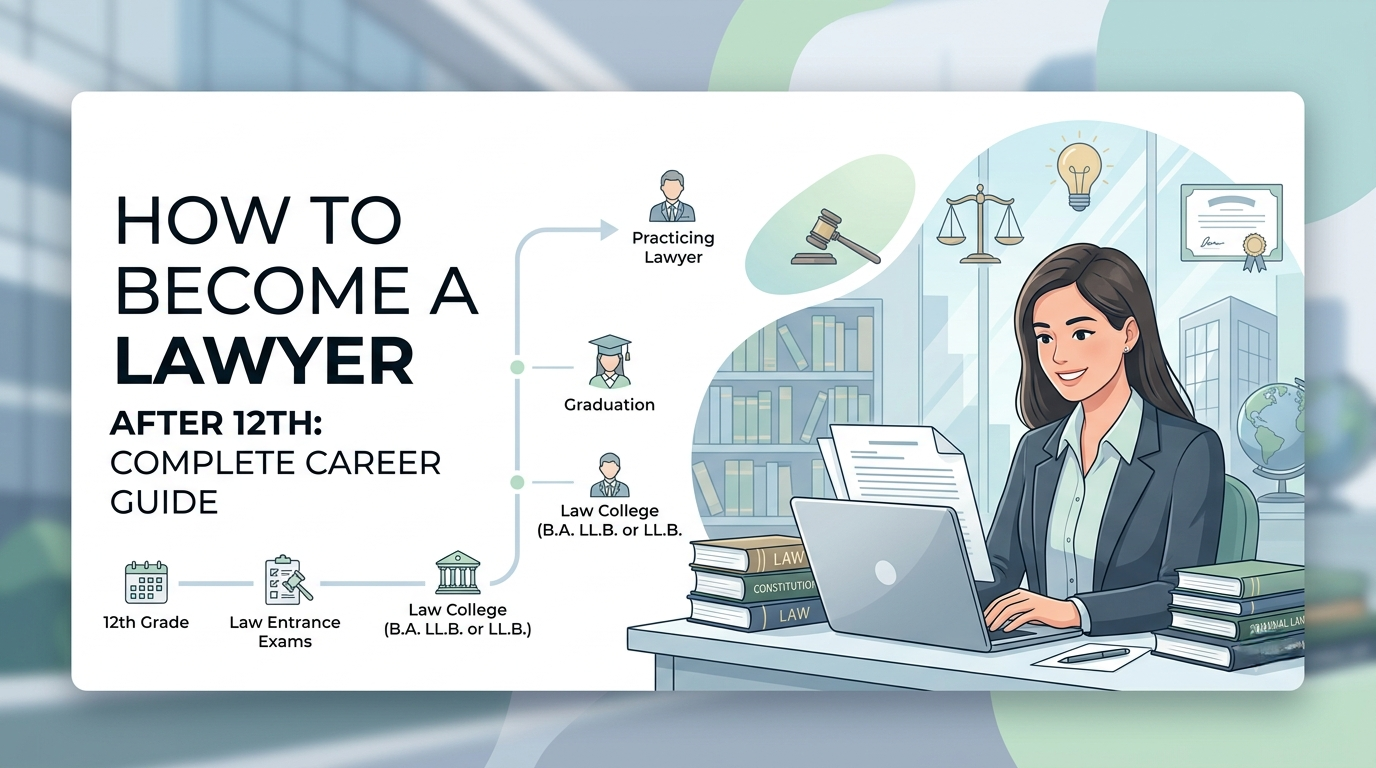
If you want to be a lawyer in India after 12th, then most integrated law degrees are for five years rather than just the short class that continues the path of students from every stream, and there is no upper age limit on any national entrance exam either.
Pass 12th with minimum marks (usually 45% but reduced to 40 for SCST), clear an entrance exam to law such as CLAT AILET SLAT or a state CET, complete a 5 year integrated LLB (BA LLB, BBA LLB or B.Com LLB) and register with a State Bar Council + pass the All India Bar Examination AIBE to earn the Certificate of Practice. That whole journey is 5–6 Years from 12th to your first day in practice.
Step-by-Step: How to Become a Lawyer After 12th
Step 1: Complete 12th From a Recognized Board
There are several reasons behind studying law after 12th stream whether they were from Science, Commerce or Arts. Commerce is preferable for business and tax law, Science is ideal for technology and cyber law while Arts creates fertile ground for constitutional and litigation practice. The minimum qualification for admission to most of the law programs is 45% aggregate marks (40% in case of SC/ST candidates) but the respective colleges may set their mark.
Step 2: Choose Between a 5-Year Integrated LLB and a 3-Year LLB
After 12th, all you have is the 5-year integrated LLB — a standalone 3-year LLB cannot be done without having completed some other bachelor first.
Route |
When You Take It |
Common Programs |
|---|---|---|
5-Year Integrated LLB |
Directly after 12th | BA LLB, BBA LLB, B.Com LLB, BSc LLB |
3-Year LLB |
After completing any bachelor's degree | LLB |
Step 3: Clear a Law Entrance Exam
Almost all reputed law colleges offer an entrance based admission. Based upon the colleges you are targeting, the exam you focus on differs:
- CLAT (Common Law Admission Test): The main entrance test for all 24 NLUs + 60+ private law colleges; most difficult of all.
- AILET: Conducted by National Law University Delhi for its BA LLB program.
- SLAT (Symbiosis Law Admission Test): For admission to Symbiosis Law School campuses.
- State-level CETs: For state law colleges and universities (e.g., MH CET Law).
A prevalent myth stopping older students from applying is that the upper age limit has been abolished — all major national law entrance exams, including CLAT, entered 2026 with no upper age limit.
Step 4: Complete Your 5-Year Integrated Law Degree
The Integrated LLB usually stretches across 10 semesters, with the undergraduate subjects (Arts/ Business/ Science) being covered along with core law papers — Constitutional Law, Contract Law, Criminal Law, Family Law and Jurisprudence. In addition to classroom learning, students do compulsory internships — with advocates, law firms, courts, NGOs or corporate legal departments — and these matter far more for your future career than which stream you came from.
Step 5: Build Practical Experience Through Moots and Internships
At law firms, moot court competitions, legal aid clinics and debate societies practice in the class what classroom reading cannot: those face-to-face practical skills that often determine whether a candidate is hired.
Step 6: Enroll With a State Bar Council
Once LLB is done you need to enroll yourself with the respective state Bar Council where you wish to operate. This registration is required by law before you are able to identify as an advocate.
Step 7: Clear the All India Bar Examination (AIBE)
The AIBE is the last hurdle — you can only practice anywhere in India if you pass it, and an enrolling officer grants a Certificate of Practice to anyone who passes!
Career Paths for Lawyers in India
After being certified and enrolling, there are multiple career paths that can take you in different directions:
- Litigation: Representing clients in criminal, civil, and family law courts.
- Corporate Law: Working with corporations on contracts, compliance, and transactions.
- Intellectual Property Law: Covering patent, trademark, and copyright issues.
- Tax Law: Advising on legal matters related to how businesses can operate from a legal standpoint.
- Judiciary: Work for 1–3 years, appear for the Judicial Services Examination, and become a judge.
Corporate lawyers, intellectual property lawyers and experienced tax lawyers tend to be paid the highest in India.
Skills You Need to Succeed as a Lawyer
- Strong research and analytical thinking
- Written and verbal communication
- Attention to detail in drafting legal documents
- Negotiation and persuasion
- Ethical judgment and discretion