
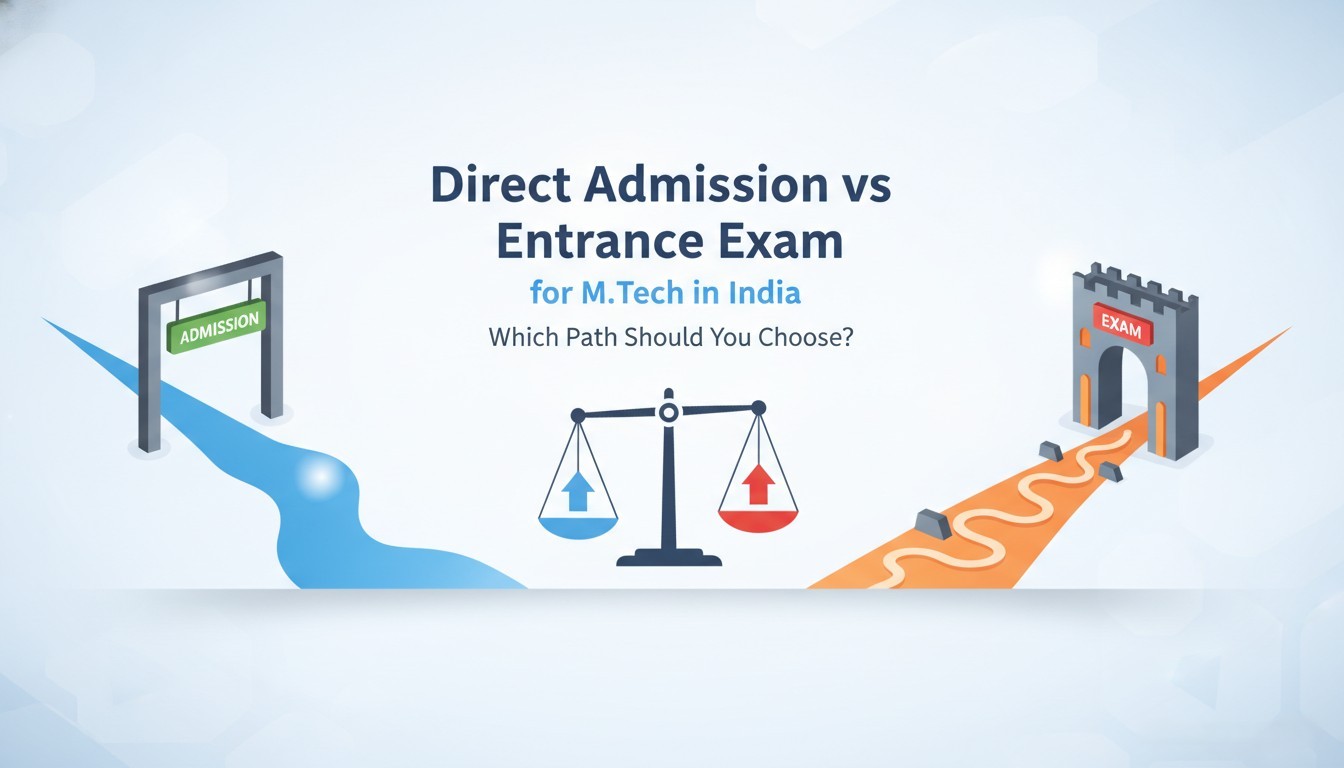
Direct Admission vs Entrance Exam for M.Tech in India: Which Path Should You Choose?
M.Tech is the most preferred option by Indian engineering graduates. That comes handy to open doors for higher paying positions, research careers or academic careers. However, one question puts a break on almost every aspirant aspiring to go ahead with their applications i.e. Should I give the GATE exam or not and can I get admittance for M.Tech directly?
But the good news is both pathways remain open in 2026–27. India's M.Tech admission landscape has evolved significantly while GATE remains the gold standard for top institutions like IITs and NITs, hundreds of universities now offer direct admission through merit-based selection, university-level entrance exams, or sponsored/management quota seats.
In this guide, we have compared both the pathways in detail, eligibility, top colleges, advantages & disadvantages and how to select the right one for your profile.
What Is Direct Admission for M.Tech?
Direct admission to M.Tech means all the admission modes in which students are not asked anything related to GATE score. This includes:
- Admission Through Merit - based selection as per your B.Tech/B.E. percentage or CGPA.
- Exams Held by Institutes — university-level entrance examinations.
- Sponsored Seats — for working professionals with 2+ years of experience in IITs and NITs.
- Management Quota Seats — direct admissions in private colleges at a higher fee.
- Quality Improvement Programme (QIP) —for college teachers with 3 years or more of experience and qualifications as prescribed by the Government of India.
What Is GATE-Based M.Tech Admission?
GATE (Graduate Aptitude Test in Engineering), a national-level entrance exam for M.Tech admissions, remains the most popular and largely accepted graduate entrance exam across India. Scores from GATE, which is organized by IITs and IISc in the Rotational cycle every February are Valid for 3 years.
Institutions using GATE scores include:
- IITs: Admission through COAP (Common Offer Acceptance Portal).
- Other Institutions: NITs, IIITs, and GFTIs → CCMT (Centralized Counselling for M.Tech./M.Arch./M.Plan. Admissions).
- State and Private Universities: Many institutions accept GATE scores along with their own admission criteria and eligibility standards.
Also, valid GATE scores make candidates eligible for MHRD/AICTE scholarships (currently ₹12,400/month for full-time M.Tech students).
Direct Admission vs Entrance Exam for M.Tech: Side-by-Side Comparison
Parameter |
GATE-Based Admission |
Direct Admission |
|---|---|---|
Exam Required |
GATE (national-level) | None / University exam / Interview |
Top Colleges Accessible |
IITs, NITs, IIITs, top private colleges | Private deemed universities, state colleges |
Scholarship Eligibility |
Yes (MHRD/AICTE) | Generally not available |
Competition Level |
Very high | Moderate to low |
Fee Structure |
Lower (especially at IITs/NITs) | Higher (especially management quota) |
Recognition |
Highest | Good, varies by college |
Flexibility |
Requires prior GATE preparation | Apply based on availability |
Suitable For |
Fresh graduates, career changers | Working professionals, GATE non-qualifiers |
M.Tech Admission Through GATE: Key Details
Eligibility
- Bachelor’s Degree in Engineering/Technology (or its equivalent) with a minimum of 50% marks (45% for SC/ST candidates).
- A valid GATE scorecard in the relevant discipline/paper.
Admission Process
- Give GATE (every year in February)
- COAP (for IITs) or CCMT (for NITs/GFTIs) - Register
- Fill up preferences and attend counselling
- Report to the allotted institute with documents
M.Tech Direct Admission: Key Details
Eligibility for Direct Admission Without GATE
- B.E./B.Tech degree with qualifying marks as defined by the respective university.
- Some admission routes require 2+ years of work experience (for sponsored seats at IITs/NITs).
- IIT direct admission for B.Tech graduates from IITs requires a CGPA of 8.0 or above.
Types of Direct Admission Routes
University-Level Entrance Exams
Some deemed and private universities have entrance tests.
Sponsored Seats (IITs and NITs)
Sponsored M.Tech seats are available for employed candidates with 2+ years of relevant work experience. The employer is to allow 2 years of study leave and finance it. This is the second most advanced non-GATE route to top institutes.
Quality Improvement Programme (QIP)
In-service teachers with at least 3 years of teaching experience can pursue M.Tech via this Government of India initiative at IITs and NITs. As per this scheme, the candidates are exempted from GATE requirement.
Merit-Based Admission
Several state and private universities consider admissions either totally based on B.Tech percentage or with personal interview / group discussion.
Pros and Cons: Direct Admission vs GATE Route
GATE Route — Pros
- Admission to top institutes (IITs, NITs) in the country.
- MHRD stipend of ₹12,400 per month.
- Greater brand value associated with the degree.
- GATE score is valid for 3 years, allowing multiple admission attempts.
GATE Route — Cons
- Highly competitive (6.5+ lakh applicants per year).
- Requires months of focused preparation.
- No flexibility if the exam cycle is missed.
Direct Admission — Pros
- No national-level exam pressure.
- Application timeline is faster and more flexible.
- Multiple colleges can be applied to simultaneously.
- Suitable for working professionals who may not want to take a mid-career break.
Direct Admission — Cons
- Restricted entry to IITs and NITs(except sponsored ones)
- No MHRD scholarship eligibility
- Privately Provided Institutions with Higher Tuition Rates
- In some recruitments, degree might be secondary to IIT/NIT credentials
Which Route Is Right for You?
Choose GATE if:
- You are a recent graduate, you have some time to prepare
- Your aim is an IIT, NIT or best IIIT
- You want scholarship support for your M.Tech
- You'd like to pursue a career in R&D or academia
Choose Direct Admission if:
- You are an experienced professional who missed or could not prepare for the GATE
- Have flexibility with application time frames
- You are pursuing or have a B.Tech degree with good CGPA and seeking admission based on merit
- Your are doing a post graduation under the QIP or sponsored seat scheme
Conclusion
The decision between direct admission in M.Tech vs GATE route is completely based on your profile, aspirations and the period you can wait. GATE gives you access to India's top engineering institutes and financial support through scholarships — but demands serious preparation. Direct admission, on the other hand, offers a flexible, accessible path to quality M.Tech programmes through private universities, sponsored seats, and university-level entrance exams.
Preparing for GATE (if you have the bandwidth to spare) is always a worthy goal. However, direct admission routes are very great opportunities for working professionals as well as students with a strong academic background without the pressure of GATE.