
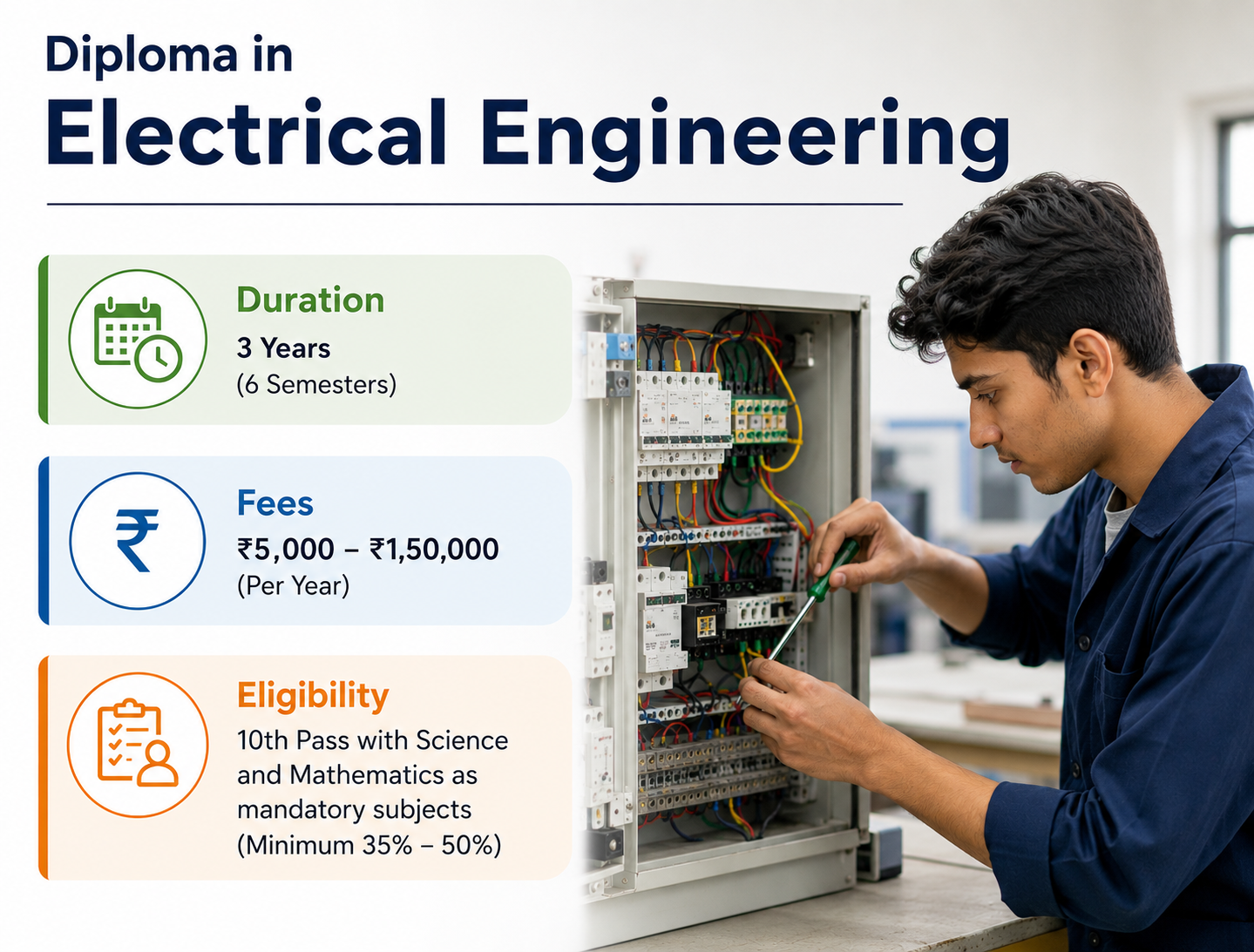
Duration, Fees, and Eligibility for Diploma in Electrical Engineering
Diploma in Electrical Engineering (EE) It is one of the ideal courses for students inclined towards electrical systems, power generation, electronics, and industrial automation. It provides the comprehensive practical and technical knowledge needed for electrical and manufacturing careers.
Here’s a complete overview of the duration, fees, and eligibility criteria for Diploma in Electrical Engineering in India.
Duration of Diploma in Electrical Engineering
In General, the duration of the Diploma in Electrical Engineering course is —
Course Type |
Duration |
|---|---|
Regular Diploma |
3 Years |
Lateral Entry Diploma |
2 Years |
The standard diploma is separated into 6 semesters, and the other one for the students participating through lateral entry is completed in 4 semesters.
Lateral Entry Option
Students who have completed:
- ITI courses, or
- 12th Class with Science/PCM subjects
to take direct admission in the second year of diploma.
Eligibility Criteria for Diploma in Electrical Engineering
There may be slight variations in the eligibility criteria depending on the respective college or state technical board.
Basic Eligibility
Candidates must:
- Passed Class 10 (Matriculation/SSC) from a recognized board
- Obtained the minimum required marks (usually 35%–50%)
- Mathematics and Science subjects may be required by some institutions
Eligibility for Lateral Entry
Students can apply for lateral entry if the have:
- ITI (Approximate duration: 1–3 years, depending on the trade)
- Completion of 12th standard with Physics, Chemistry, and Mathematics (PCM)
This enables students to enter directly the 2nd year of the diploma.
Fees for Diploma in Electrical Engineering
Diploma in Electrical Engineering Fee Structure varies on:
- Government vs. Private College
- State and Location
- Infrastructure and Facilities
- Placement Support
Average Fee Structure
College Type |
Approximate Fees |
|---|---|
Government Polytechnic Colleges |
₹5,000 – ₹30,000 per year |
Private Polytechnic Colleges |
₹30,000 – ₹1,50,000 per year |
Additional Expenses
The tuition fee is not the only payment students have to make, sometimes a cost for:
- Examination Fees
- Laboratory Charges
- Uniforms
- Hostel and Accommodation
- Books and Study Materials
Other institutes also provide merit based or on the bases of entrance exams.
Key Takeaways
- The course duration is usually 3 years after Class 10.
- Lateral entry students can complete the diploma in 2 years.
- Eligibility generally requires passing Class 10 from a recognized board.
- Course fees can range from ₹5,000 to ₹2 lakh or more, depending on the institution.
- Government colleges typically have lower fees, while private colleges often offer better infrastructure and placement support.
Final Thoughts
The Diploma in Electrical Engineering provides technical education and practical working skills early on for the students who need them. This course has a lot of job prospects in power plants, electrical maintenance, manufacturing, automation and public sector units like railways.
Students can either:
- Start working immediately after completing the diploma, or
- Enroll in B.Tech lateral entry programs for higher studies.
This diploma is a very good technical qualification and with the increasing demand of skilled electrical professionals in India, it will be an added advantage for candidates.