
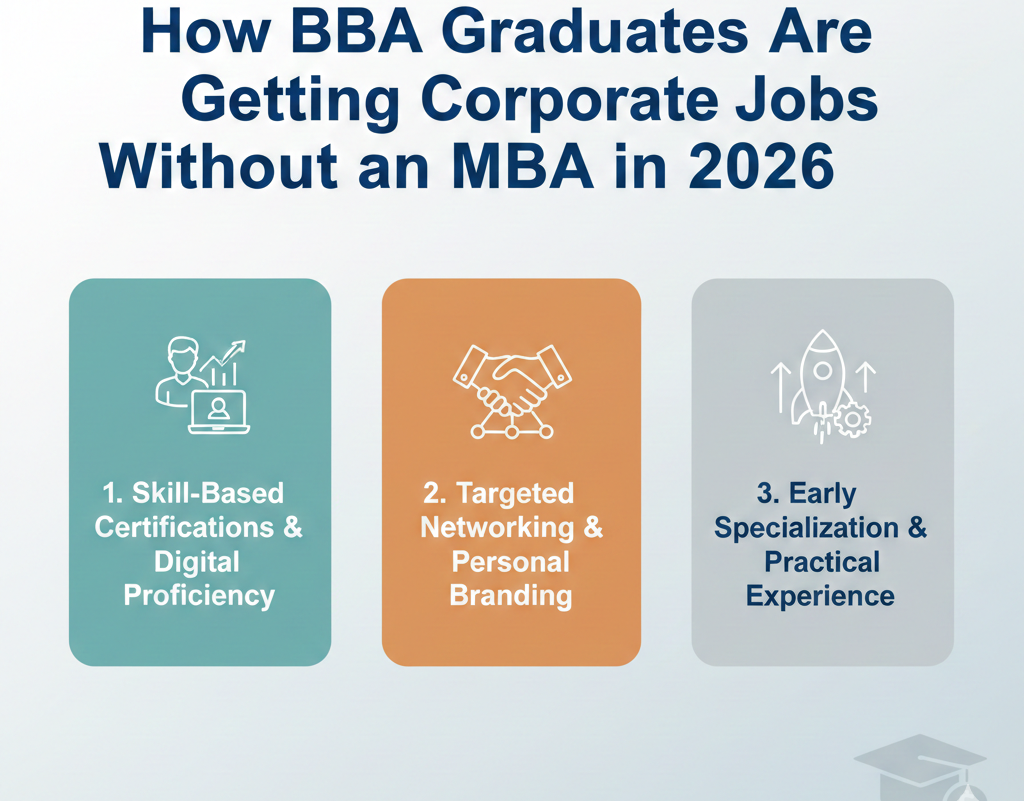
Students, people have been thinking about, that BBA after MBA is only way to get the good corporate job. But that belief is dissolving rapidly in 2026. Today, several BBA graduates are getting corporate jobs without an MBA and they are doing well in terms of salary, growth and job satisfaction. Companies are no longer just looking for degrees. Talent recruitment is based on Skills, Work exposure, and Business insight.
If you are a BBA graduate still in two minds as to whether pursuing an MBA is worth your time and money, have no doubts, this blog will provide the answer to your dilemma. Let's show you how BBA students are getting into corporate roles without an MBA in 2026, what skills they are learning and what strategies actually do work.
MBA for corporate roles is either no longer required or rapidly losing its relevance
2026: The corporate environment is even more results-focused. Employers need people who can solve problems, manage responsibilities and hit the ground running. An MBA is great, but an MBA no longer suffices as the sole means of proving yourself.
Many companies now believe that:
- Practical skills are more important than academic credentials
- Experience beats classroom theory
- Short-term specialization may trump long degrees
Consequently, BBA graduates with the proper attitude are effectively passing over the MBA path.
Corporate Recruiting: What’s Different in 2026
Technology, startups and global competition have done in corporate hiring. Recruiters focus on:
- Job-ready skills
- Industry knowledge
- Communication and teamwork
- Digital and analytical ability
In such a climate BBA degree holders, on skill upgrade can be competitive with MBA graduates.
The New Normal Is Hiring Based on Skill
There are reasons why BBA graduates are getting corporate jobs without an MBA And one of the main is skill-based hiring. Companies screen for what you can do, not what you studied.
2026’s most important skills are:
- Business communication
- Data interpretation
- Digital tools and platforms
- Problem-solving mindset
BBA passouts already have management as their foundation. When you layer in practical skills, they are job-ready.
Short Term Professional Courses After BBA
Short-term courses have emerged as a strong contender to MBA. These are the courses which will cover the specific job roles and industry demands. Some of the certifications pursued by BBA graduates include:
- Digital marketing
- Business analytics
- Financial modeling
- HR analytics
- Project management
These programs take less time, cost less and provide faster entry into corporate jobs.
Job position being assumed by BBA Graduates Where one does not need an MBA!
- Business development executive
- Marketing analyst
- Operations coordinator
- HR executive
- Client relationship manager
They go on to lead as managers without having earned an MBA.
Value of internships / outside world exposure
Corporate Jobs are benefitted a lot from internships. Many are concentrating on internships rather than holding out for an M.B.A. offer.
Internships help in:
- Understanding corporate culture
- Building professional networks
- Gaining hands-on experience
- Improving resumes
Internships often result in full-time job offers.
How Networking Is Replacing Degrees
In 2026, the networking is as crucial as the education. BBA graduates who attend:
- Industry events
- Corporate workshops
- Business seminars
- Online professional communities
Receive job offers and calls for interviews. Powerful professional networks provide opportunities that degrees simply do not.
Entry Level Corporate Positions As a Growth Strategy
A lot of BBA graduates also begin from corporate entry-level jobs and then nurture themselves over a period of time. Corporations would rather promote employees who know the company than hire new MBAs.
This strategy helps graduates:
- Learn business processes deeply
- Gain internal promotions
- Build long-term corporate careers
Development will be slow, but it is solid and sober.
BBA Graduates Gaining the Upper Hand with Digital Skills
Knowing the details has become a big advantage. For example BBA graduates that study tools such as:
- CRM systems
- Marketing automation
- Data dashboards
- Business software
are highly valued. These are skills that are seldom taught in a deep way in traditional MBA programs.
Start-Ups Where You Don’t Need an M.B.A. to Get Ahead
Startups are among the largest employers for BBA graduates who don’t have MBAs. Startup founders focus on:
- Attitude and adaptability
- Skill execution
- Business understanding
They don’t really care about degrees, but they very much care what you have to offer.
MBA not Required Sales Marketing Corporate Jobs
MBA is not always necessary- Sales and marketing are such two aspects. Performance matters more than qualification.
BBA alumni find success in these positions by:
- Understanding customer behavior
- Using data-driven strategies
- Improving communication skills
Post- BBA Operations and Supply Chain Jobs
Staff roles emphasize system and co-ordination and execution. The recruitment of BBA graduates is done based on operations experience and without the need for an MBA degree.
Companies value:
- Organizational skills
- Decision-making ability
- Process improvement mindset
Can You Do HR Without an MBA?
Yes, a lot of BBA grads in HR without an MBA. They start as HR professionals or recruiters and gain experience and certifications.
Modern HR focuses on:
- Employee engagement
- Talent analytics
- Performance management
Corporate Certifications That Can Replace an MBA Value
Certifications are helping BBA graduates to give a tough fight to MBA holders in 2026. Employers view them as evidence of specialization.
Mental Break: How to Think Like a Corporate Player
BBA’s that don’t go on to get an MBA learn about professionalism early. They:
- Take responsibility seriously
- Learn continuously
- Accept feedback positively
- Focus on long-term growth
Salary Growth Without an MBA
Starting pay might not be as high as for top MBAs, but career growth is a function of:
- Performance
- Skills
- Experience
Most non-MBA professionals catch-up or even outearn their MBA counterparts within several years.
When an MBA Still Makes Sense
Most BBA grads do just fine without an MBA, but it doesn’t hurt if you are interested in:
- Senior leadership roles early
- Career switch into niche domains
- Global corporate exposure
Conclusion
An MBA is no longer a prerequisite for corporate success in 2026. Graduates belonging to the BBA stream are proving that with the relevant skills, experience and mindset, they can crack and thrive in corporate jobs without an MBA.
Your career should result from strategy, not pressure.