
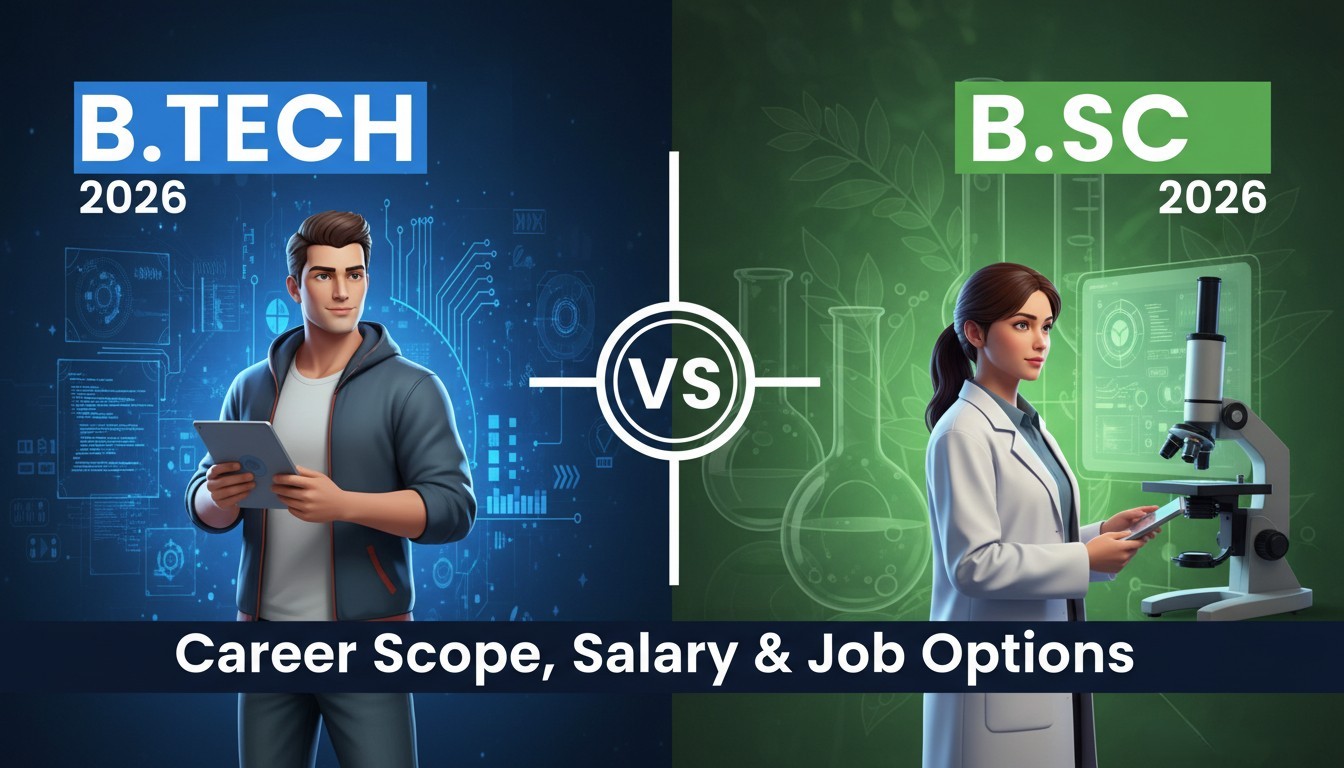
B.Tech vs B.Sc: Career Scope, Salary & Job Opportunities
Choosing between a B.Tech course and a BSc course is one of the most important decisions a science student makes after Class 12. Both degrees open distinct career paths — but which one is right for you? This comprehensive guide breaks down everything you need to know about b tech vs bsc — from fees and eligibility to salary and job opportunities. Whether you are passionate about engineering or love pure science, read on to make an informed decision that shapes your entire career.
What Is a B.Tech Course?
B.Tech: Bachelor of Technology is a 4-year undergraduate degree program in engineering that applies majorly scientific and mathematical principles to resolve real-world technical issues. One of the most popular professional degrees in India, this programme is offered by IITs and NITs as well as thousands of private engineering colleges.
B Tech is also offered in other domains such as Computer Science, Mechanical Engineering, Civil Engineering, Electronics & Communication, Electrical Engineering and Information Technology. Students learn by way of theory, lab work, an industry internship training and a final year project specifically designed for the requirements of the Industry.
Qualifications: 12TH PASS (by Science) – Must have prepared Class 12 in Physics, Chemistry and Mathematics along with JEE Main and Advanced scores or BITSAT/CET-States exams.
Admission Open for B.Tech Agriculture 2026 Apply Now
What Is a BSc Course?
A BSc course (Bachelor of Science) is an undergraduate program with a duration of 3 years that focuses on theoretical and applied sciences. This program is for students who hope to develop in-depth scientific knowledge in a special field before seeking postgraduate studies or research careers.
For the BSc course there are different streams like Physics, Chemistry, Maths, Biology, Computer Science, Biotechnology, Agriculture & Nursing. The M.Tech program provides a solid academic footing and is the step to an M.Sc Ph. D and other government jobs with the help of competitive exams such as UPSC, SSC, state PSCs etc.
Who this course is for: Students who have completed Class 12 in the Science stream. Now, colleges admit students on the basis of merit and they are naturally not going to be looking into them too for admissions; some very top end institutes like Delhi University even have cutoffs based on Class 12 marks.
Admission Open for BSc Course 2026 Apply Now
B.Tech vs B.Sc: Key Differences You Must Know
Before understanding the main differences that most of you might think of between B.Tech and B.Sc let me firstly give an overview of these.
Just, if we compare b tech vs bsc, the practical annual duration gap goes lengthy. B.Tech is a 4-year professional degree highly focused on applied engineering and technology while BSc is a 3-year academic degree centered in theoretical and pure science.
Speaking about fees, the 4-year B.Tech course is extremely costly which ranges from ₹1.5 lakh to ₹15 lakh every year according to the organization. On the other hand, a BSc course is comparatively much cheaper, with an annual fee of between ₹10,000 and ₹1.5 lakh available to most students.
The entrance process also differs. To qualify for B. Tech courses, one must clear competitive national level examinations such as JEE Main, JEE Advanced or BITSAT. Most BSc admissions are merit-based with respect to Class 12 marks but some universities conduct their entrance tests like BHU.
Regarding the professional path, B.Tech course is mostly associated with industrial and corporate IT jobs in technology, engineering and manufacturing. The BSc course is more suited to research, teaching and government service trends — albeit usually as a follow up with a postgrad degree.
Career Scope: B.Tech vs B.Sc
Career Scope After B.Tech Course
The career opportunities after a B.Tech course are enormous and industry-oriented. BTech jobs1B tech graduates are highly sought after in IT, manufacturing, infrastructure and defence and also for banking tech roles as well as the start up job-market. TCS, Infosys, Wipro, Google, Amazon, Microsoft and L %amp; T DRDO ISRO have been among the top recruiters.
As AI, machine learning, cloud computing and electric vehicles skyrocket the B.tech-trained engineers career has an incredible boost in the upcoming decade. GATE for M-Tech admissions or PSU exams (BHEL, ONGC & NTPC) are other options available to B. Tech graduates and postgraduates.
Career Scope After BSc Course
The BSc course prepares one for research careers, such as a faculty position at the university/college level and many government jobs. Students can opt for M.Sc after BSc to enjoy specialization, which opens up lucrative job prospects and better salaries.
Following graduation, BSc graduates can also take the UPSC Civil Services examination followed by SSC CGL (Staff Selection Commission- Combined Graduate Level), state government examinations, Railway recruitment through RRB and CTET/state TET for teaching jobs. The increasing demand of the pharmaceutical, biotechnology and environmental field is also another active hire for BSc graduates.
Salary Comparison: B.Tech vs B.Sc
When it comes to evaluating the b tech vs bsc salary, B.Tech graduates usually secure a much higher pay in contrast to all other types of undergraduates at the entry level. A fresher B.Tech graduate earns a starting salary of approximately ₹6.5 LPA in average with the range going up to around ₹3.5 lakh per annum to over ₹20 lakh per year at top colleges including IITs. Packages have run over ₹1 crore and past from best global organizations in the ongoing campus placements at top IITs.
On the other hand, a fresh BSc graduate generally starts at an average salary figure of ₹3 LPA with a range from two lakh to six lakh per annum. Nevertheless, this picture transforms to a large extent after postgraduation. M. Sc or PhD After BSc Graduate A Ph. D from a prestigious institution like IISc or JNU can command ₹5 lakh to ₹10 lakh per year in research and specialised scientific roles, significantly narrowing the income gap.
Job Opportunities After B.Tech
- Wide Career Scope: B.Tech graduates can explore careers in IT, core engineering, management, and startups
- Software & IT Roles: Popular options include Software Engineer, Web Developer, and App Developer in top tech companies
- Data & Analytics Careers: Roles like Data Analyst and Data Scientist are in high demand across industries
- Core Engineering Jobs: Mechanical, Civil, and Electrical engineers can work in construction, manufacturing, and infrastructure sectors
- AI & Machine Learning: Emerging field with roles like AI Engineer and ML Engineer offering high growth
- Networking & Cloud Roles: Opportunities as Network Engineer, System Engineer, and Cloud Engineer
- Management Opportunities: Roles such as Product Manager and Business Analyst for those interested in business + tech
- Government & PSU Jobs: Careers in organizations like BHEL, ONGC, and NTPC through competitive exams
- Startup & Entrepreneurship: Scope to launch your own startup or join growing companies
Job Opportunities After BSc
- Diverse Career Paths: B.Sc graduates can explore careers in science, research, education, government, and healthcare sectors
- Research & Lab Roles: Opportunities as Research Scientist, Lab Technician, and Analyst in labs and research organizations
- Teaching Careers: Become a school or college teacher after higher studies like M.Sc or B.Ed
- Government Jobs: Options like UPSC, IAS, Bank PO, SSC, and other competitive exams
- Healthcare & Pharma Roles: Careers as Pharmacist, OTC Specialist, or Biotech Analyst
- Specialized Fields: Roles such as Agriculture Officer and Environmental Scientist
- Higher Studies Advantage: Pursuing M.Sc opens doors to advanced research, academic, and senior-level positions
Conclusion
The answer to the B.Tech vs B.Sc debate depends entirely on your personal goals, interests, and budget. If you are interested in engineering, technology, or building products and want immediate high-paying industry jobs after graduation, the B.Tech Course is the right choice for you. If you love science deeply, aspire to research or government service, or need a more affordable degree before pursuing postgraduate studies, the BSc course is the smarter path.
A B.Tech Course from a top college like IIT or NIT offers unmatched salary and career prospects right after graduation. A B.Sc Course followed by an M.Sc from a reputed university like IISc or JNU is equally powerful for research and academic careers. Neither degree is universally better — the best choice is the one that aligns with your passion, strengths, and long-term vision.
Admission Open for BSc and B.Tech Courses Apply Now