
BCA, B.Tech, or BSc CS: Which Course is Best for an AI Career?
AI is no longer the future — it has become one of the fastest-growing job markets today. However, at the age of standing at the crossroads after 12th and looking at three different degrees BCA or B.Tech CSE or BSc Computer Science degree, confusions mount.
All three teach programming. Each one has its own open doors into the tech world. However, all three are not on equally firm footing when it comes to building a career in AI and machine learning.
This guide will deconstruct precisely what each course provides, how they differ and which one is right for you based on your goals — so that you can make an informed decision, not a guess.
What Each Course Actually Covers
This might help you to understand what you're signing up for before comparison.
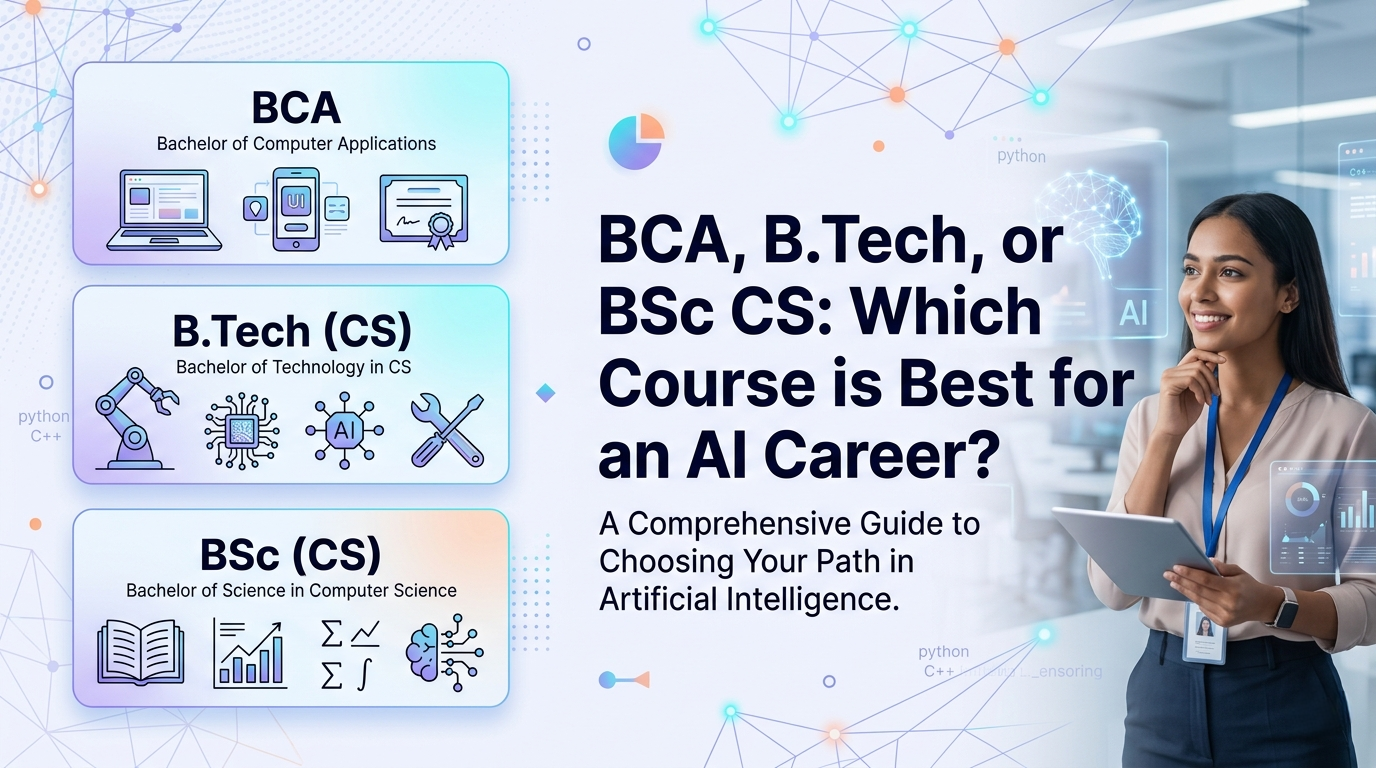
BCA (Bachelor of Computer Applications) is a 3 year under-graduation Program which is a completely practical development and application base course. It includes programming, databases, web development and basic data structures — but usually skimps on advanced math and core engineering topics.
Bachelor's (Engineering) B.Tech CSE (Bachelor of Technology in Computer Science & Engineering) is a 4-year technology degree, B.Tech CSE is an engineering subject developed as a balanced combination of theoretical computer science, mathematics, electronics and practical programming. It is the most well filled out CS degree that you can get as an undergraduate student in India.
B.Sc Computer Science is a 3-year science course in between — it is mathematically stronger than the BCA but not as deep into engineering as B.Tech. It typically covers some statistics, discrete mathematics, and algorithms in a more structured way than BCA.
Which Course Has the Strongest Foundation for AI?
The three components of AI, machine learning are math(mostly known linear algebra, calculus and probability), programming (python, data structures, algorithms) and data — collect it, clean it, model it.
This is how each of these courses fares:
Criteria |
BCA |
BSc CS |
B.Tech CSE |
|---|---|---|---|
| Math depth | Low–Medium | Medium | High |
| Programming rigour | Medium | Medium–High | High |
| AI/ML specialisation options | Limited | Moderate | Extensive |
| Industry recognition | Good | Good | Very high |
| Duration | 3 years | 3 years | 4 years |
Advantage B.Tech CSE on AI Readiness – the sheer foundation in mathematics provides B.Tech graduates a real jump-start when getting into ML frameworks, neural networks, and statistical modelling. Most top AI/ML job descriptions in India clearly prefer B. Tech or equivalent engineering graduates, if not ask for it specifically.
For all that, it is by no means an unbridgeable gulf. BCA & BSc CS graduates with focused certifications in data science, machine learning and Python carve out great careers in AI, especially if their degree is from a university that focuses on emerging tech curriculum changes.
BCA for an AI Career: Who Should Choose It?
BCA is a smart choice if:
- You did not study Physics, Chemistry, and Mathematics (PCM) in Class 12, making many B.Tech programs inaccessible.
- You are more interested in entering the technology job market sooner through a 3-year degree rather than a 4-year engineering program.
- You want to learn practical AI applications, such as building AI-powered products, tools, and chatbots, rather than focusing on advanced AI research.
- Your long-term goal is to pursue an MCA or a specialized postgraduate program in Artificial Intelligence or Data Science.
Top benefit: Most universities now offer BCA in AI & Data Science specialisation, which means students will get exposure to Python, machine learning libraries and data analytics from Year 1 itself.
Limitation: The curriculum lacks sufficient math coverage, and you will possibly have to take concrete efforts in building the relevant skills for linear algebra or statistics to get a job in some advanced AI roles.
B.Sc CS for an AI Career: Who Should Choose It?
B.Sc CS falls into the middle of some interesting ground. It has stronger theoretical foundations than BCA — specifically in algorithms, math and system concepts — which makes it a viable route to AI roles especially those relating to data analytics, research support and applied ML.
Choose B.Sc. Computer Science if:
- Strong science/math background since 12th grade, prefer University-based degree instead of an Engineering institute.
- You want to add AI into a field like Biology, Physics, or Statistics (these are often found in academia and research environments).
- You are obviously aiming for an AI or Data Science Master's degree after completing your undergraduate degree.
Key advantage: Many leading universities have altered BSc CS curricula to make it relevant for entry-level AI jobs, with an introduction of electives in data science and AI along with research projects allowed.
Limitations: Lesser industry facing as against B.Tech, some employers still perceive it to be a level lower than engineering degree in shortlisted candidatures.
B.Tech CSE for an AI Career: The Strong Default
If you want a career in AI — ML engineer, AI researcher, data scientist or product engineer wannabe at any tech company — B.Tech CSE is the most straightforward and well-accepted entryway.
Why B.Tech leads for AI:
Advantages of a B.Tech CSE Program:
- Offers advanced mathematics, including Probability, Statistics, and Linear Algebra, as part of the core curriculum.
- Most modern Computer Science and Engineering (CSE) programs include dedicated courses in Artificial Intelligence (AI), Machine Learning (ML), and Data Structures.
- Provides an employability-focused qualification recognized by leading Indian and global employers across technology, BFSI, healthcare, and manufacturing sectors.
- Develops an engineering mindset with strong systems thinking, optimization, and problem-solving skills that are essential for AI-related roles.
The universities that provide B.Tech CSE with AI & ML specialisation take a step ahead: the students pass out with not only the engineering fundamentals but also practical acquaintance with deep learning, NLP, computer vision and cloud-centric AI tools.
The Honest Bottom Line
Neither is a strictly "wrong" decision here but there certainly is one that is more clear-cut.
If you have a math background and are willing to devote four years to pursuing it, B.Tech CSE is the most solid groundwork for an AI career. It is the great degree that top firms actively hire from and the one that leaves the most doors ajar — whether we are talking about academic research, product development or looking to study internationally at a higher level.
If you are academically solid but wish to pursue a science-route degree and have the determination to gain relevant certifications and complete projects,BSc CS is a decent option.
BCA is an excellent option if time or proficiency has been a constraint, especially when combined with the right specialisation and a robust AI project portfolio.
Depending on what, the AI world rewards those who create things, not just study them. Go choose your course — the best foundation for all that you are going to build.