
10 Top Skills Every MSc HIM Graduate Needs to Succeed in IT in 2026
The momentum in health domain is now on the fast-track toward digital, data-in place and technologically driven operations. This transformation has opened up huge opportunities for MSc HIM (Health Information Management) pass-outs in the IT Industry.
By 2026, as hospitals, health-tech companies, insurance providers and enterprises of global IT firms are on the look out for workforce overseeing healthcare data, systems for digital records, analytical tools and regulatory compliance processes. But it’s not simply a degree that makes people successful. It is the job-specific IT skills that are necessary to create a successful career with high-paying jobs.
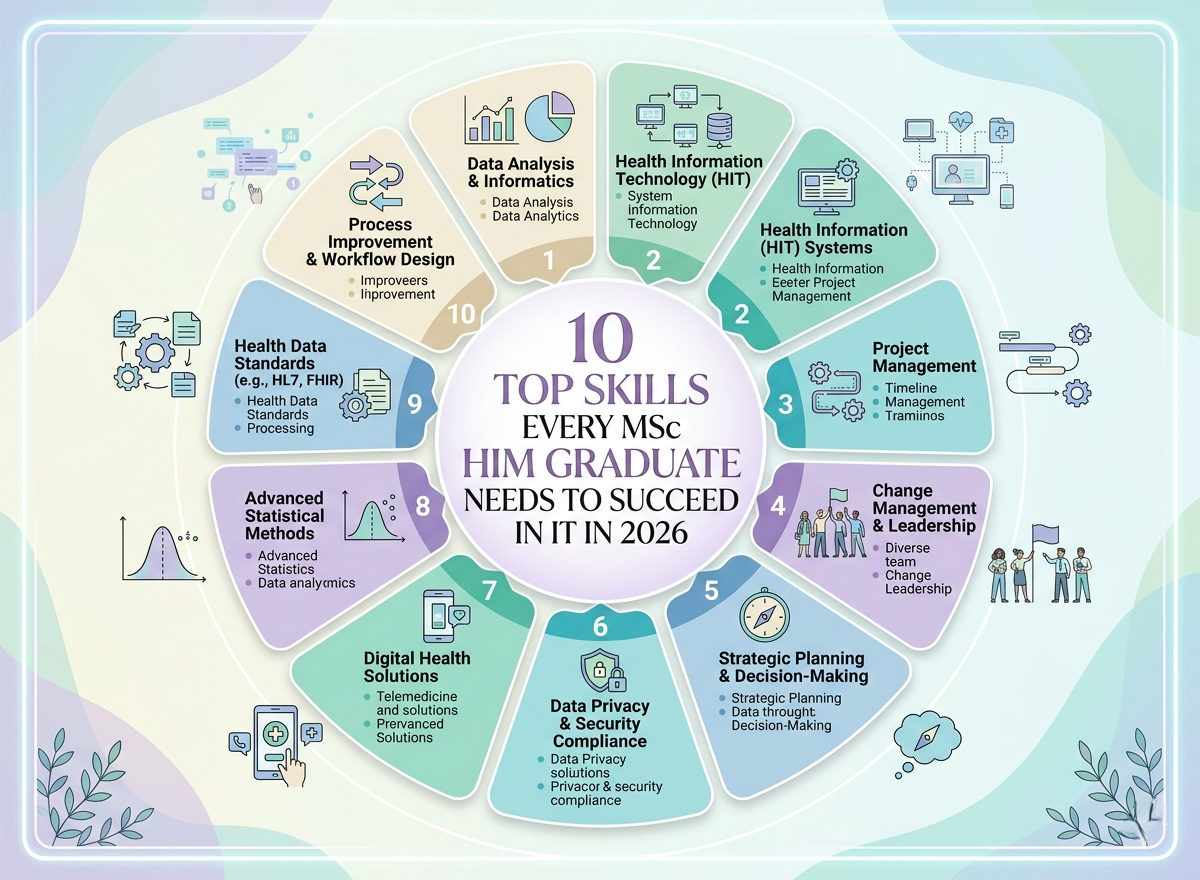
This blog describes the 10 skills every MSc HIM graduate needs to advance in IT careers in 2026, putting them into easy-to-understand terms with real-world context.
The Importance of IT Skills for MSc HIM Graduates in 2026
Healthcare is no longer paper-based. Most organizations now rely on:
- Electronic Health Records (EHR)
- Healthcare analytics
- Cloud-based hospital systems
- AI-driven decision support tools
- Data security and compliance frameworks
Graduates from the MSc HIM programme, who have skills in both computer science and healthcare, are an important asset to the digital health domain.
Electronic Health Records (EHR) Management
IT careers for HIM graduates are built on EHR competency.
What this skill includes:
- Managing patient digital records
- Understanding EHR software workflows
- Ensuring data accuracy and completeness
- Supporting clinicians with system usage
Why it matters:
Virtually every hospital and a health care IT company runs EHR systems. There is always a need for professionals who have the unique knowledge of clinical data and IT systems.”
Healthcare Data Analytics
Healthcare IT sector are one of the areas in which analytics is experiencing fastest growth.
What you need to know:
- Interpreting patient and hospital data
- Creating reports and dashboards
- Identifying trends in healthcare outcomes
- Supporting decision-making using data
Career advantage:
Analytics are used by organizations to save money, increase care quality and plan services. MSc HIM graduates who have analytics skills earn more and get promoted sooner.
Medical Coding and Classification Systems
Who knew? Medical coding. It's the vital link between health and IT.
Key areas to master:
- ICD-10 and ICD-11 coding
- CPT and HCPCS systems
- Clinical documentation improvement (CDI)
- Coding audits and accuracy checks
Why it’s important:
Accurate coding results in appropriate payments, maintains compliance and impacts quality metrics. Coded data is crucial for IT systems.
Health Information Systems (HIS) Knowledge
HIS is the cornerstone of electronic hospitals.
This skill covers:
- Hospital management systems
- Laboratory and radiology information systems
- Integration of multiple healthcare platforms
- Workflow optimization through IT
Why IT companies value it:
Implementation and support Staff Who know how health system connect and communicate digitally Professionals who understand how healthcare systems connected are crucial for implementation and support roles.
Data Privacy, Security, and Compliance
Healthcare Data Privacy is the priority for 2026.
What you should understand:
- Patient data confidentiality principles
- Healthcare data protection laws
- Risk management and access control
- Secure data handling practices
Career impact:
Community hospitals receiving all PII from corporations and individuals have risks as well: HCOs are fined heavily in the event of a breach. Data security right now, is being well paid, and you will be very trusted, if you're good at this.
Basic IT and Database Skills
Each MSc HIM graduate going into IT should have baseline technical skills.
Important areas:
- Database concepts
- Data storage and retrieval
- Basic SQL understanding
- Healthcare data structuring
Why it helps:
This skills will help you to work effectively with IT teams, developers, and analysts without needing anyone else.
Clinical Documentation and Quality Management
Lessons You are only as good as your documentation for quality of care.
This skill involves:
- Maintaining accurate clinical files in their entirety
- Supporting accreditation and audits
- Improving documentation standards
- Maintaining data consistency
Why employers need it:
IT systems are only as good as the information that goes in to them. HIM professionals ensure data quality and compliance, which is vital for both hospitals and insurers.
Skills in Health Informatics and Digital Transformation
It is a mix of Health care, IT and administration.
What you should learn:
- Digital health workflows
- Telemedicine systems
- AI and automation in healthcare
- Interoperability between systems
Future advantage:
This skill sets you up for leadership positions within health-tech or digital hospitals.
Communication and Stakeholder Coordination Skills
IT positions in healthcare demand constant collaboration.
Why communication matters:
- Articulating technical information to non-technical team members
- Collaborating with doctors, nurses and IT teams
- Training users on digital systems
- Managing IT implementation projects
Career benefit:
Good communicators develop more rapidly into managers and consultants.
Problem-Solving and Analytical Thinking
Health IT systems are under constant pressure.
This skill helps you:
- Identify system errors
- Resolve data inconsistencies
- Improve workflows
- Support continuous system improvement
Why it’s essential:
IT employers want problem solvers, not service workers.
IT Career Positions for Which MSc in HIM Graduates Can Aim in 2026
With those skills graduates can find employment as:
- Health Information Analyst
- EHR System Executive
- Healthcare Data Analyst
- Medical Coding Auditor
- Health IT Consultant
- Clinical Data Manager
- Health Informatics Specialist
These are jobs with rapid growth and long-term stability.
Pay Progression of the Skilled MSc HIM Professionals
Compensation Based on abilities, organizational and work experience:
- IT entry-level positions provide stable packages
- Skilled professionals see rapid increments
- Committee on publications proposed categories with analytics and informatics either higher or same payscales
- Worldwide healthcare IT positions pay top dollar
Workers who improve their skills regularly make much more money in the long term.
Future Scope of MSc HIM in IT
Health care is digital in the future. By 2026:
- More hospitals will go paperless
- Health-tech startups will expand
- AI-driven healthcare systems will grow
- Data security roles will increase
- Global need for HIM practitioners will grow
- MSc HIM graduates mastering IT will continue to be future-ready and internationally marketable.
Conclusion
An MSc in Health Information Management has the potential to be a great career move – but like any IT role, you need the right skills. With expertise in EHR platforms, analytics, data security, informatics and communication skills – MSc HIM graduates can create high-growth, high-income career paths within the healthcare IT industry by 2026.
The combo of healthcare knowledge + IT skills is one of the best career cushions to have on your resume in this job market.